
For a garden greenhouse range, assess ventilation as a combination of opening size, position, operation and customer use. Ask for a drawing of the roof vents and doors, confirm what is included in the quoted model, and check how replacement parts will be supplied. A vent count alone does not establish cooling performance.
Importers and retail buyers comparing greenhouse kits often receive clear dimensions and glazing options but less detail about ventilation. A catalogue may show an open window without explaining its usable opening, operating hardware or whether the pictured configuration matches the quotation. Those gaps are easier to resolve before approving a sample than after customers begin assembly.
This guide focuses on greenhouse ventilation for small garden structures sold through UK and European retail channels. It provides a specification checklist for buyers rather than an industrial climate-control design.
What should greenhouse ventilation achieve?
Buyers should separate three functions: bringing outdoor air into the structure, allowing indoor air to leave, and moving air around plants. A fan that circulates indoor air does not necessarily provide an exchange with outdoor air. Ask suppliers to identify the function of each proposed opening or accessory.
The RHS guidance on greenhouse ventilation and shading identifies doors, roof vents and side vents as possible air routes. It also highlights the overheating risk in small greenhouses and the need to monitor conditions. These principles are useful when reviewing a layout, but they do not certify the performance of a particular kit.
Define the customer’s intended use before selecting a configuration. A greenhouse used by someone who is home during the day presents different operating needs from one left unattended. The buying brief should also identify the expected site exposure, access restrictions and whether additional shading will be considered.
Compare roof vents, doors and optional equipment
| Item | What to request | What not to assume |
|---|---|---|
| Roof vent | Location, opening dimensions, hinge details, stay or opener, and closing method | That every greenhouse size has the same number or arrangement |
| Door opening | Door type, clear opening and instructions for safe operation | That a door can be left unsecured or open in all weather |
| Side vent or louvre | A model-specific drawing and confirmation of inclusion or availability | That a side vent shown on another brand’s model is available on the quoted kit |
| Automatic opener | Mounting compatibility, load information, operating instructions and replacement parts | That an opener described as universal fits every frame |
| Powered equipment | Separate scope, installation requirements and applicable documentation | That a fan, wiring or controller is included with the greenhouse |
Compare configurations on the same basis. A lower quotation with manual window stays is not directly equivalent to an offer that includes compatible automatic openers. Record the difference as a separate line in the quotation comparison instead of leaving it inside a general accessories description.
Why vent count is not a complete specification
Two roof windows can differ in panel dimensions, opening angle and the clear space available when open. The same nominal window may also behave differently when a shelf, shading product or adjacent structure restricts its movement. A photograph of an open vent cannot resolve all of these details.
Request an annotated layout showing the selected greenhouse footprint, roof-window positions, door position and any proposed additional openings. Ask the supplier to explain how opening area has been described or measured. Keep that definition consistent when comparing models; a panel’s overall dimensions and its effective opening are different measurements.
Do not convert a generic rule of thumb into a guaranteed temperature reduction. If a procurement decision depends on a cooling or airflow claim, request evidence for the specified configuration and the stated conditions. Where evidence is unavailable, keep the claim out of customer-facing materials.
Manual or automatic operation: what should buyers check?
A manual roof vent needs instructions that show how to open it, hold it at the intended position and close it correctly. Check that the hardware in the sample matches the assembly guide and bill of materials. Review access to the stay or handle from the intended customer position.
Automatic openers require a separate compatibility check. Ask for the precise opener reference, mounting arrangement, operating limits, maintenance guidance and spare-part route. If the greenhouse supplier has not approved an opener for the model, describe it as a buyer requirement to investigate rather than a supplied feature.
The RHS notes that wax-cylinder openers have a response delay. A buyer should therefore review the overall ventilation arrangement and user instructions rather than presenting automation as a guarantee against overheating.
For a private-label range, distinguish the greenhouse kit, optional opener pack and any separately sourced equipment in product data, cartons and instructions. That separation helps distributors answer compatibility questions without promising accessories that were never included.
Small greenhouse ventilation: make the operating space clear
Compact products deserve their own review. Ask whether the buyer’s intended placement leaves room for the door and roof window to operate. A photograph taken in an open garden does not establish the clearance available beside a wall, hedge, fence or balcony boundary.
Check the layout with the proposed shelving and plant-support arrangement. These items should not obstruct access to window hardware or prevent an opening from moving as designed. If shelves are optional, record the approved combination rather than assuming every accessory fits every product size.
A useful retail listing explains the supplied ventilation features and points customers to the operating instructions. Avoid broad descriptions such as “complete automatic climate control” unless the quoted equipment and supporting evidence justify them.
Confirm closing details and future upgrades
Ask to see how the roof window closes and how the stay or opener is secured. For a range intended for use across seasons, request the operating instructions for cold weather as well as warm weather. Review any supplied seals and their replacement details. Do not describe the structure as airtight, draught-proof or suitable for a particular winter temperature without evidence for that configuration.
If future upgrades matter to the range, ask whether an extra window or opener can be fitted to the approved frame and glazing. Confirm the required parts, fitting instructions and any effect on the supplied product’s support terms. A matching nominal panel size does not establish compatibility, and an option available on a competitor’s greenhouse should not be offered as a LERYOU feature without confirmation.
What LERYOU buyers can discuss
LERYOU’s standard polycarbonate greenhouse product information describes adjustable roof windows and rain gutters, with door and size options depending on the selected configuration. Its T-shaped polycarbonate greenhouse direction also includes roof windows and a rain gutter. Final window quantities, positions and operating hardware should be confirmed for the selected model.
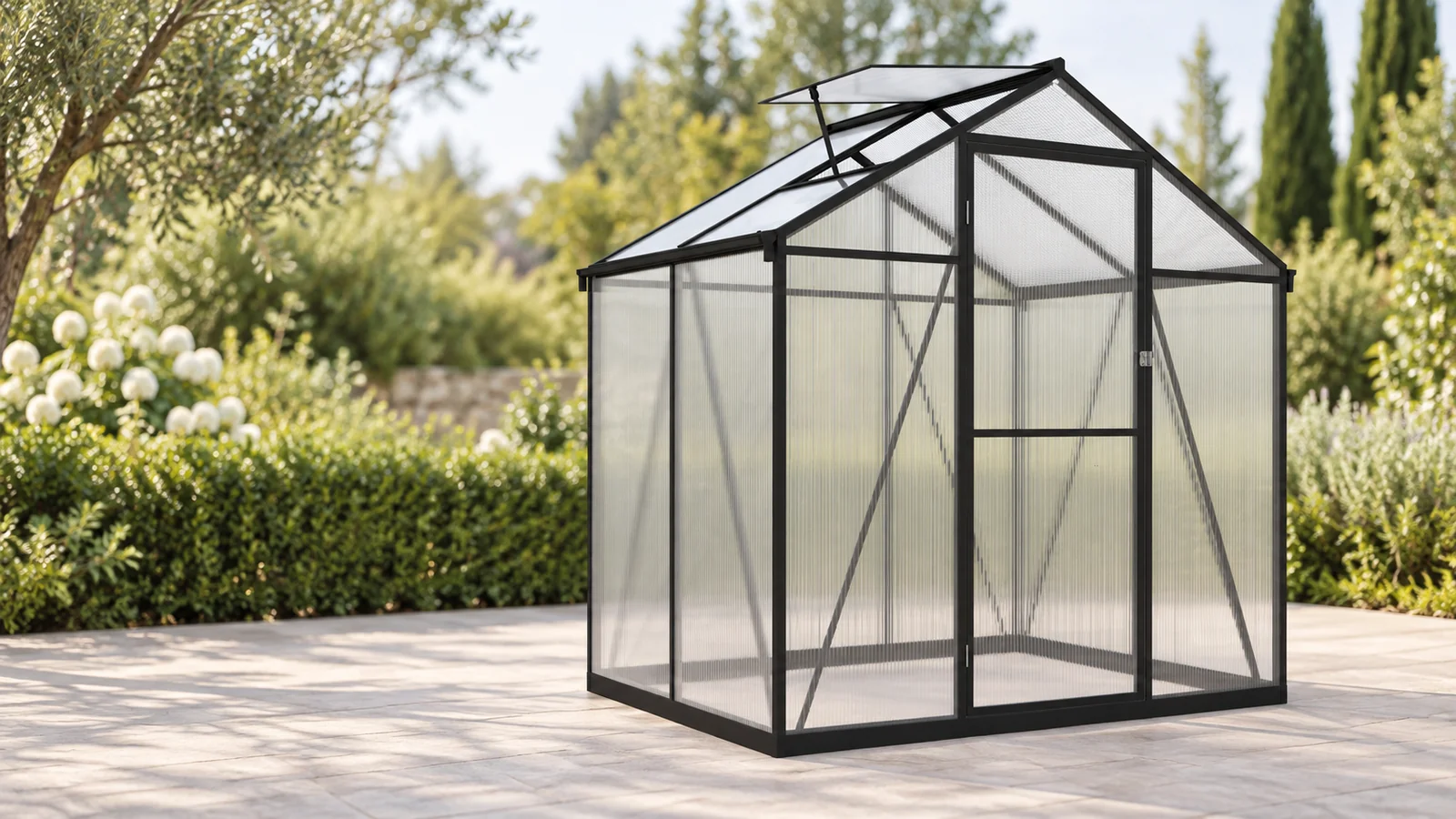
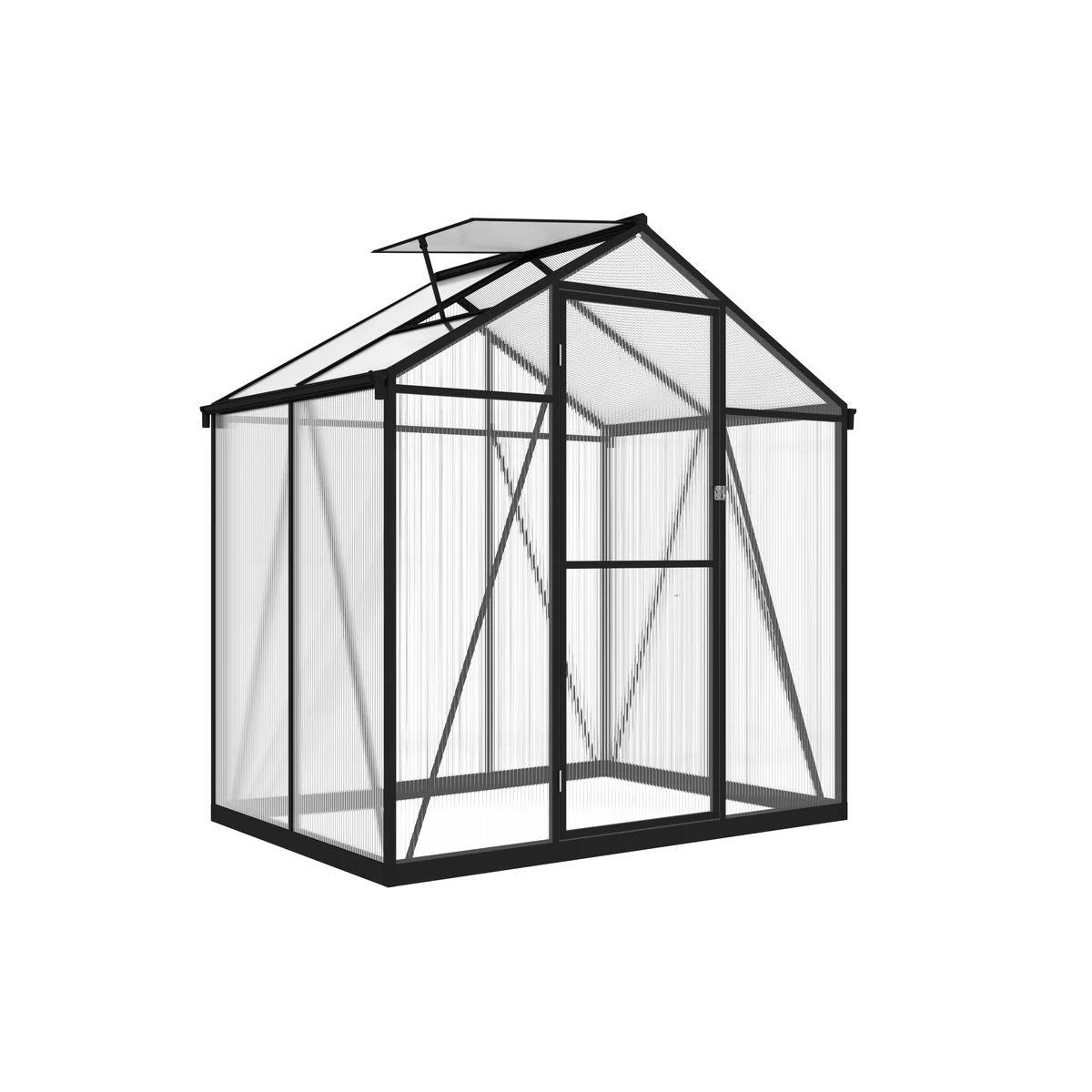
The product reference shown here has a single hinged front door and a raised roof window held by a stay. It illustrates one arrangement; it does not establish that every LERYOU greenhouse uses the same door or window layout.
Begin with the polycarbonate greenhouse product range, then use the garden greenhouse design comparison to identify the product form. For glazing decisions, see the polycarbonate panel specification guide. Keep material selection and ventilation configuration as separate approval items.
A rain gutter manages roof runoff; it is not a ventilation opening. Confirm its outlets and supplied parts separately from the window arrangement. Automatic openers, side louvres, fans, screens and sensors should only appear in the buying specification when their inclusion and compatibility have been confirmed.
RFQ checklist for a greenhouse ventilation specification
Send one configuration sheet per proposed range item. Include the following fields so supplier responses can be compared directly:
- Target market, retail channel and intended garden use.
- Greenhouse dimensions, glazing choice and door arrangement.
- Required roof-window quantity, positions and opening information.
- Manual operation or a request for a compatible automatic opener.
- Any proposed additional openings, clearly separated from the standard kit.
- Window stays, hinges, handles, seals and other supplied hardware.
- Instructions for opening, securing, closing and maintaining the vents.
- Replacement-part identification and the proposed ordering process.
- Packaging identification for loose hardware and optional equipment.
- Any requested performance claim and the evidence needed to support it.
Use the greenhouse specification checklist for the wider product brief. Keep the quotation, approved sample, component list and final product listing aligned. A feature should not appear as standard in the listing if it was only discussed as an optional upgrade.
Frequently asked questions
What is the best ventilation for a greenhouse?
There is no single arrangement that suits every garden greenhouse. Compare the available openings, their positions, operating hardware and intended use. For procurement, ask for the selected model’s layout and scope before deciding whether extra equipment is needed.
How does a greenhouse ventilate?
Air passes through openings such as roof windows and doors; some designs also have side vents. The actual route depends on the structure and how those openings are used. Confirm which openings are supplied rather than assuming a photographed accessory is included.
Should a small greenhouse have ventilation?
Yes. Ventilation needs to be considered when selecting a small greenhouse. Review the roof-window and door arrangement, available operating space, and the customer’s ability to manage the openings. Small size alone is not evidence that a closed structure will avoid overheating.
Are natural ventilation, powered ventilation and circulation the same?
No. Natural ventilation relies on openings and air movement. Powered ventilation uses equipment to move air into or out of the structure. Circulation moves air within the structure and does not by itself establish an outdoor-air exchange. Specify the function you need.
Are automatic vent openers included with LERYOU greenhouses?
Do not assume they are. Confirm the operating hardware in the quotation and approved component list. If automatic operation is required, request model-specific compatibility information before adding it to customer-facing product data.
Can extra roof vents or automatic openers be fitted later?
Only if compatibility has been confirmed for the specific frame, glazing and hardware. Ask for the approved kit and fitting instructions before describing an upgrade as available. Do not assume that a nominally similar window or a universal opener fits every greenhouse.
What information should an importer request before approving the range?
Request a configuration drawing, vent and door details, supplied hardware list, operating and maintenance instructions, optional-equipment scope and replacement-part information. Ask for configuration-specific evidence whenever a proposed listing includes a measurable performance claim.
Discuss your greenhouse range with LERYOU
Share your target market, proposed sizes, glazing choice and ventilation requirements. LERYOU can review the product direction and clarify the configuration to be quoted. Send your greenhouse sourcing brief.
 English
 Deutsch
 Français
 Español
 Italiano
 Polski
 日本語
 한국어
 Nederlands
 Čeština
 Português do Brasil
 Русский
 ไทย
