
An outdoor parcel box should make it clear where a delivery goes, which packages fit and how you collect them afterwards. A large box with a lock is not necessarily a system that can accept another parcel once the door is locked.
Start with the delivery sequence, then compare the opening, usable space and installation position. This guide covers simple storage cabinets, dedicated parcel-drop designs and planter-top options, with practical checks for choosing a box that suits your entrance and typical deliveries.
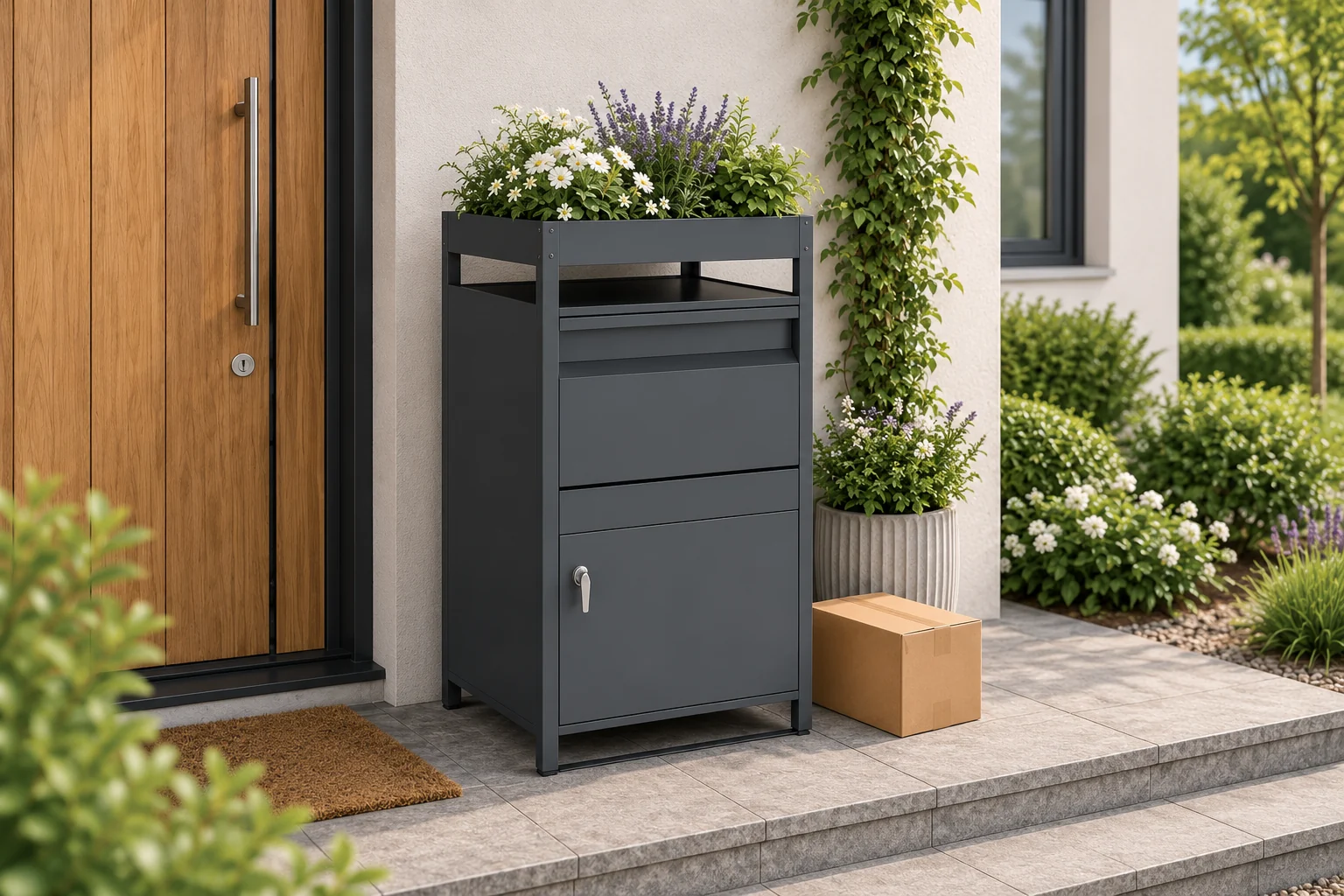
Decide whether you need storage or unattended delivery
An outdoor storage box for parcels can provide a place to keep packages, but the access arrangement determines how a courier can use it. Walk through what happens when the box is empty, after the first delivery and when you return to collect the contents.
| Type | Access arrangement to check | Best starting question |
|---|---|---|
| Simple lockable cabinet or chest | The delivery and retrieval may use the same door or lid. | How does a courier open it, and what happens after it is locked? |
| Separate deposit and retrieval box | A delivery opening leads to a compartment collected from another door. | Can another parcel enter while the retrieval door stays locked? |
| Planter-top box | A planting area is combined with a cabinet or deposit system. | How do the actual delivery mechanism and planting compartment work? |
| Shared multi-user lockers | Separate compartments and an access-management arrangement serve different recipients. | Who receives each parcel, controls access and manages collection? |
A planter is an exterior feature, not a description of the delivery mechanism. Likewise, the word “smart” does not tell you whether a box needs electricity, an app or a code. Compare the documented operating sequence for the particular model.
Measure the parcel opening as well as the box
Keep four measurements separate: the outside dimensions, the clear delivery opening, the maximum parcel size and the usable holding space. Each answers a different question. Outside dimensions help with siting; maximum parcel dimensions help establish what can pass through the delivery route.
Measure the length, width and height of packages you regularly receive, including their outer packaging. Compare all three dimensions with the stated maximum and the permitted insertion direction. A long, narrow parcel may behave differently from a shorter, deeper one, even if their volumes are similar.
- Outside dimensions: include projecting lids, handles and planter edges.
- Clear opening: identify the unobstructed width and height where the package enters.
- Delivery path: check any drawer, flap, turn or internal moving component.
- Holding space: consider existing parcels and the room needed for the mechanism to operate.
- Retrieval opening: check that you can remove the package comfortably.
A litre capacity alone cannot confirm parcel fit. A box may have ample storage volume while its delivery opening limits the size of the package that can enter. Avoid choosing only by the external footprint or a photograph showing a parcel beside the unit.
Check what happens after the first delivery
Ask for the complete sequence with the retrieval door closed and locked. Some dedicated designs provide a deposit mechanism that can be used again; other boxes rely on a courier opening a shared lid or following a particular locking sequence.
For repeated deliveries, check whether the deposit mechanism returns to its ready position and how the box indicates that it is full. Existing packages must leave room for the next delivery and for any moving parts. A “multiple parcels” description is more useful when it explains both the mechanism and its space limits.
Keep lock type and delivery access separate. A key lock on the retrieval door does not establish a one-way deposit route. If a model uses codes or other controlled access, review how authorised delivery access is managed and what happens when access is unavailable.
Choose a position that works for delivery and collection
Place the box where an arriving courier can identify it without obstructing the entrance, gate or normal walking route. Check the space used by delivery flaps, lids and retrieval doors when fully open. A cabinet that fits neatly beside a wall may still need more working room in front or behind it.
Wall-mounted, floor-fixed, fence-integrated and freestanding formats have different installation requirements. Use the selected model’s instructions to confirm the supporting surface, fixing positions and supplied hardware. Choose the format before preparing the site.
Consider rain exposure and ground drainage at the same time. Keep the access area clear of standing water and look at roof runoff, splash and exposed seams. A sheltered position can reduce exposure, but it does not replace the product’s own installation and care requirements.
Compare construction, locks and weather information
For a steel box, review the body, frame, doors, joints and finish as one assembly. Powder coating describes a surface finish; it does not alone establish how openings, seams or the base manage rainwater. Timber and plastic alternatives also need product-specific checks for access, construction and care.
Read “lockable” as a feature description. If a tested security level matters to your choice, look for evidence identifying the exact model, configuration and test scope. Lock hardware, concealed contents and a manufacturer’s security wording are different kinds of information.
Similarly, compare the evidence behind weather-resistance claims rather than treating every outdoor box as having the same protection. Check any documented rain-exposure limits, drainage details and recommended placement, and follow the specified cleaning guidance for the finish and moving parts.
For a planter top, review water and weight
A planting area can help an outdoor parcel storage box suit the entrance visually. Its practical details matter just as much as the finish. Check whether the planter uses a removable insert, how water leaves it and where that water goes relative to the parcel compartment.
Ask for the permitted planting arrangement and load, including wet growing material and plants. Keep foliage clear of the delivery opening, retrieval door and lock. Check that routine watering and clearing the drainage area will remain convenient after installation.
Use the manufacturer’s specified planter and drainage arrangement. Do not assume that the presence of a tray in a photograph establishes its load limit, water path or suitability for any size of plant.
Make the delivery instructions easy to follow
A suitable box still needs a clear delivery plan. Where your retailer or courier provides delivery preferences, identify the location and the correct deposit opening. Explain the actual sequence for your model and provide an alternative for packages that do not fit.
Check the delivery service’s own arrangements for items requiring a signature or other confirmation. A box label, barcode or delivery note does not by itself establish that a service will accept that method as proof of delivery.
Keep the approach clear and inspect the box periodically. Remove parcels before the holding area becomes full, clear leaves from the planting area and follow the care instructions for the lock, hinges and coating.
Compare LERYOU’s planter-top steel option
LERYOU’s planter-top outdoor parcel box combines a powder-coated steel enclosure, an upper delivery opening and a lower retrieval door with a lock. Compare its opening direction, parcel path and collection access with the space at your entrance.
For the steel construction, our guide to metal panels, frames and connections explains why individual components should be checked separately. Parcel-opening and lock details still need to be assessed for the selected box.
To review a configuration, share your parcel sizes and available installation space with LERYOU. Include the delivery and retrieval directions you need, typical package sizes and whether a planter top is part of the layout.
Frequently asked questions
What size parcel fits in an outdoor parcel box?
Use the model’s maximum parcel dimensions and clear delivery opening, not its outside size alone. Compare length, width, height and the intended insertion direction.
Can a locked box accept more than one delivery?
It depends on the deposit and locking mechanism. Check whether another parcel can enter while the retrieval compartment remains locked and how a full box affects the next delivery.
Does a planter-top box always have a separate deposit system?
No. The planter describes an exterior arrangement. Review the actual opening, parcel path and retrieval mechanism for the model you are considering.
Is a lockable parcel box theft-proof?
A lock does not establish an absolute theft-proof claim. Compare any documented security testing for the exact model and follow its installation requirements.
Can I leave any outdoor parcel box fully exposed to rain?
Check the selected product’s weather information, installation instructions and exposure limits. Review the openings, seams, base and planter drainage together.
Will every courier use the parcel box?
Do not assume universal acceptance. Provide clear instructions through available delivery preferences and check arrangements for signatures, oversized packages and other exceptions.
What should I check before fixing the box in place?
Confirm the support and hardware requirements, delivery opening, retrieval-door clearance, normal walking route and drainage. Use the instructions for the exact configuration.
 English
 Deutsch
 Français
 Español
 Italiano
 Polski
 日本語
 한국어
 Nederlands
 Čeština
 Português do Brasil
 Русский
 ไทย
