
An outdoor storage cabinet should make the things you use easy to find, reach and put away. The best starting point is the equipment you want to store: its dimensions, how often you use it and whether it needs an uninterrupted tall space or separate shelves.
A cabinet can fit neatly against a wall yet still be awkward if its doors cannot open fully or its shelves interrupt the space needed for a rake. This guide explains how to compare useful storage space, access, materials and placement before choosing a garden cabinet.
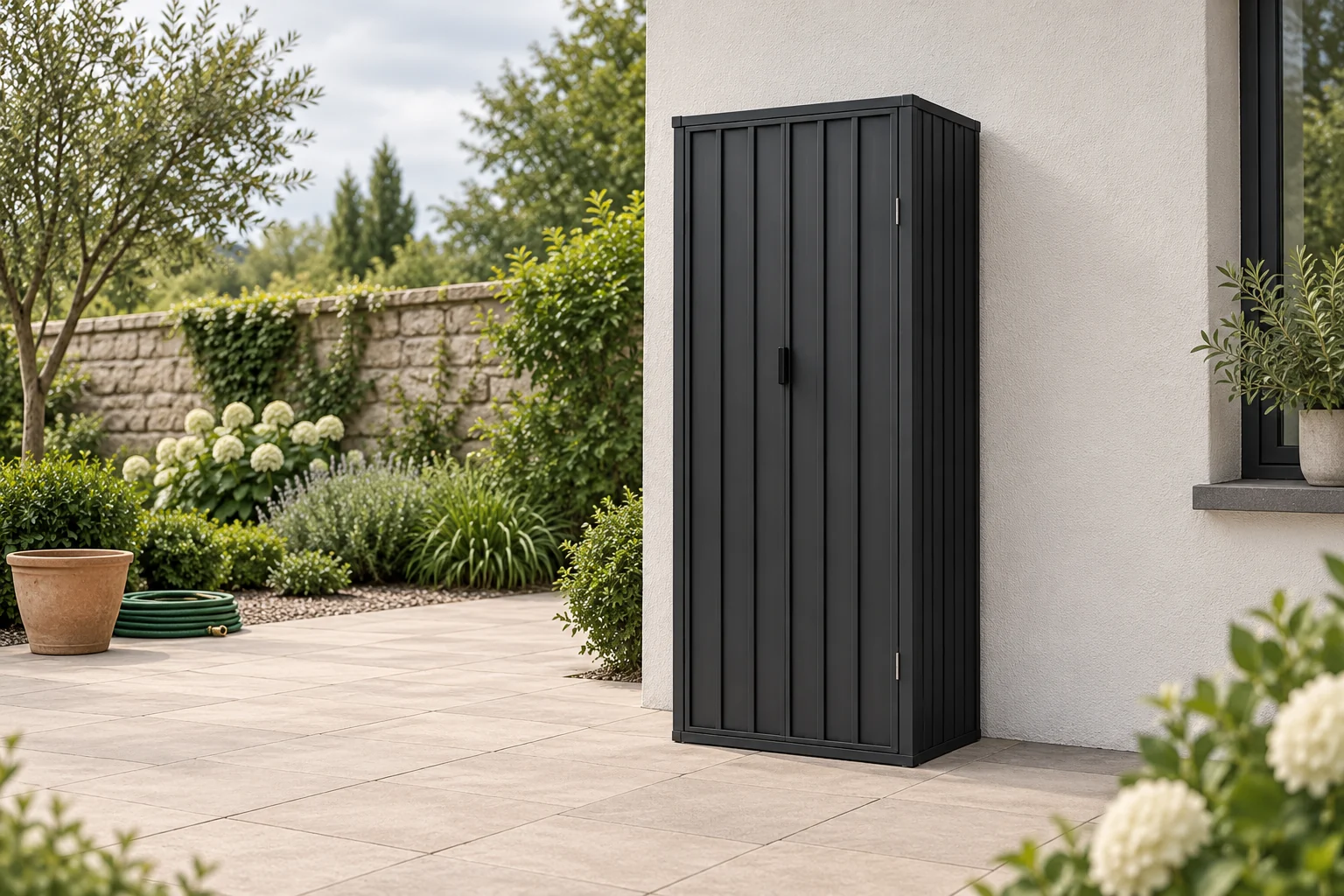
Choose the storage layout around your equipment
List the items first, then group them by the space they need. Long-handled tools need height and a clear route through the door. Watering cans, pots, gloves and small hand tools usually benefit from shelf space that is easy to see and reach.
Keep frequently used items near the front of the arrangement. If you have to remove several things to reach the tool used every day, a larger capacity label will not solve the access problem.
| Storage format | Useful starting point | Access check |
|---|---|---|
| Tall cabinet or locker | Vertical storage and a compact footprint | Clear internal height, door opening and any shelves crossing the tall space |
| Low cabinet | Smaller equipment organised on shelves | Shelf depth, door swing and reaching items at the back |
| Storage box | Items stored in a horizontal compartment | Lid clearance and retrieving items beneath other contents |
Cabinet and locker names overlap. Look at the drawing and opening arrangement rather than relying on the label. A low cabinet may have front doors without a lifting top, while a taller unit may provide shelving without a separate long-tool bay.
Compare outside size, usable space and the opening separately
The outside width, depth and height help establish where a garden storage cabinet will stand. They do not tell you how much clear space remains behind the door frame, around the hinges or above the base.
Measure the items you intend to store, including handles, wheels and other projections. Then compare the dimensions that control their route into the cabinet. A watering can may fit on a shelf but still be awkward to turn through a narrow opening.
- Outside dimensions: include the roof edge, handles and other projecting parts.
- Clear door opening: check usable width and height with the doors in their operating position.
- Interior dimensions: identify the space available after the frame, base and fittings are allowed for.
- Shelf dimensions: compare usable depth and width, including any lips or supports.
- Working clearance: leave room to stand, open the doors and lift items in and out.
Use litres as a broad capacity description alongside these measurements. Volume alone cannot confirm that a long tool fits upright or that a wide container will pass through the door.
Check how shelves and long tools share the interior
For an outdoor tool storage cabinet, the shelf arrangement can matter as much as overall height. A full-width shelf partway up the cabinet interrupts the vertical space below it. Check the uninterrupted height available for the longest tool you want to store.
Ask whether shelves are supplied, optional or added separately. Shelf brackets do not necessarily mean that shelf boards are included. If shelves are described as adjustable, establish the available positions and how the arrangement changes the usable space.
A drawing showing a full-height bay beside shelving can be useful for mixed equipment. Check that this is the supplied configuration and that any tool holders or hooks are included. Avoid planning around removing fixed components that form part of the cabinet’s structure.
For heavier items, use the documented load limit for the selected shelf and its stated loading arrangement. Shelf count, metal appearance and cabinet size do not establish a load rating. Also check whether the published figure applies to each shelf or the whole cabinet.
Compare materials through construction and care
Steel, resin and wood appear across outdoor storage ranges. Compare the construction and care instructions of the particular cabinet, along with the appearance you want in the garden.
| Material | Details to compare | Care information to request |
|---|---|---|
| Coated steel | Wall and frame construction, coating, base, joints and fittings | Cleaning instructions and how to address coating damage or worn fittings |
| Resin or plastic | Panel construction, reinforcement, shelf supports and door operation | Compatible cleaners, exposure guidance and replacement-part availability |
| Wood | Timber treatment, roof covering, joints and finish | Any treatment or finish renewal required for the chosen product |
LERYOU’s outdoor metal storage cabinet range includes slim and wider steel configurations, with shelving and door options across the range. Some configurations use galvanised steel shelves. Compare the selected cabinet’s interior arrangement, door format and base details together.
Keep the wall material separate from the finish and fittings. A description such as “metal cabinet” does not tell you whether the roof, shelves, back panel and base all use the same construction.
Plan the position and door movement together
Mark the cabinet footprint on the proposed site and add the door-opening space. Check nearby walls, steps, window ledges, gates and planting. Allow room to approach with the largest item you intend to store, as well as space to stand while opening the cabinet.
A narrow wall-side position may suit the closed cabinet but obstruct its hinge side or prevent a door opening far enough. With double doors, review the space used by both leaves and any restrictions caused by a central frame or latch.
Check the installation instructions before preparing the support. Confirm the required surface, whether a floor or base is included, and the specified fixing arrangement. Identify any hardware or site preparation supplied separately. Keep these requirements tied to the exact model.
Review rain exposure, moisture and locking
Compare the manufacturer’s description of rain protection with the cabinet’s intended position. Roof edges, door overlaps, joints and ventilation openings are useful details to review. A broad outdoor-use label gives less information than a clear description of the selected cabinet’s exposure limits.
Rain entering from outside and moisture accumulating inside are different issues. Let damp tools dry before putting them away, avoid trapping wet contents in the cabinet and keep any specified ventilation openings clear. Review moisture management alongside rain protection when choosing where to place the unit.
Check how the doors latch and lock, whether a separate padlock is needed and how keys or replacement hardware are obtained. Lockability describes an access feature. A stated security rating needs its own documentation for the particular product.
Frequently asked questions
What size outdoor storage cabinet do I need?
Measure your equipment and the proposed site. Compare the clear opening, interior dimensions and shelf layout as well as the outside size. Include space for opening doors and handling the equipment comfortably.
Will a tall cabinet fit long-handled tools?
Check the uninterrupted interior height and the position of shelves or tool holders. The outside height alone is insufficient. Measure the longest item and review how it passes through the opening.
Are cabinet shelves always adjustable or included?
No. Shelves, support rails and brackets can be separate parts of the specification. Confirm the supplied quantity, usable dimensions and permitted positions for the selected configuration.
How much weight can each shelf hold?
Use the documented limit and loading instructions for that model. Check whether the figure applies to a single shelf or the complete cabinet. Do not infer capacity from the material or shelf thickness in a photograph.
Are outdoor storage cabinets waterproof?
Check the specific product’s documented rain and exposure claims. Also review how internal moisture is managed. A rain-resistant enclosure does not automatically keep damp contents or humid air dry.
Does the cabinet need a base or ground fixing?
Follow the chosen model’s installation requirements. Confirm the support, floor or base scope and required fixings before preparing the site. The supplied package may differ between configurations.
Should I choose a cabinet or a storage box?
Compare front-door access and shelving with lift-up access to a horizontal compartment. Think about the items you use most often and the room available for opening. Choose the format that keeps regularly used items accessible.
Build a cabinet comparison around what you store
Bring together your item measurements, available footprint, opening clearance and preferred shelf arrangement. Contact LERYOU to discuss cabinet configurations and the product details needed for your garden storage plan.
 English
 Deutsch
 Français
 Español
 Italiano
 Polski
 日本語
 한국어
 Nederlands
 Čeština
 Português do Brasil
 Русский
 ไทย
