
Choosing a privacy screen for pergola seating starts with a specific view: who can see into the space, from where, and at what time? A screen across the wrong side may leave the dining table overlooked while making the route into the garden less convenient. A blind that looks reassuring in daylight may also look different once the lights come on.
Before choosing a material, make a short record of the views you want to interrupt. Then match the proposed side system to the actual pergola opening and check how people will enter, operate and maintain it. These three decisions are more useful than selecting by a nominal size or the word privacy alone.
Start with the view you want to interrupt
Mark the sofa, dining chairs and normal standing positions on a simple plan. Add the directions of nearby paths, neighbouring seating areas and elevated windows. Check the view from your own garden and any agreed viewing positions.
A straight view through a side opening is different from a diagonal view around a corner or a downward view from above. Closing one side may address the first while leaving the others unchanged. Start with the side that matters most, then check whether a return or another arrangement is needed without sacrificing the main entrance.
Compare four everyday situations
Use the intended seating positions and the proposed screen material for the same checks. If possible, view a sample vertically at the location rather than judging it flat on a table.
| Situation | What to observe | Question for the layout |
|---|---|---|
| Seated in daylight | The view towards faces and the tabletop | Does the screen cover the useful part of this sightline? |
| Standing in daylight | Visibility at a higher eye level and around edges | Is a corner or upper view still open? |
| Seated after dark | Visibility with the intended pergola and house lights on | Are people or activities more visible through the material? |
| Moving through the space | The route between the house, seating and garden | Can people pass without repeatedly opening a screened side? |
Mesh appearance depends on the weave, colour, viewing angle and lighting on either side. Daytime screening is not a dependable promise of privacy after dark. A percentage describing fabric openness or solar performance also does not tell you a percentage of visual privacy. Compare the exact material under the conditions in which you want to use it.
Choose side screens for pergola layouts by function
Fabric blinds, slatted panels and glass sides can all change a pergola, but they change it in different ways. Choose the result before choosing the mechanism.
- Retractable fabric screens: useful when you want to vary the covered part of an opening. Check the fabric and the gaps around it, plus the space occupied by the housing, guides and lower rail.
- Slatted panels: provide an architectural pattern that interrupts some viewing directions. Gaps and slat angles matter; a front-on photograph cannot show every view through them. Fixed and sliding panels also have different access implications.
- Glazed sides: retain daylight and outward views. Clear glass retains inward views too, so it does not perform the same task as an obscuring panel. Opening and stacking arrangements need their own space.
A zip-guided screen retains fabric at its side guides; the term describes part of the construction rather than a privacy grade. Likewise, choosing a net option does not describe how the complete perimeter, entrance or lower edge closes. Separate the desired visual result from shade, insect exclusion and weather shelter.
Match the accessory to the bay, not the roof label
When comparing an outdoor privacy screen for pergola use, keep three dimensions separate: the outside structure, the clear opening and the complete screen assembly. They are related, but they are not interchangeable ordering dimensions.
Record the clear distance between supporting members and the available height beneath the beam. Then identify where the proposed housing, guides, brackets or panel tracks would sit. The fabric itself may be narrower than its complete assembly. Face-mounted and between-post arrangements can require different measurements even on the same frame.
Use real frame sizes without turning them into screen sizes
LERYOU’s metal pergola range includes overall formats of 250 × 250 × 250 cm and 500 × 250 × 250 cm. These are structure dimensions. They do not specify a screen’s fabric width, finished drop or fixing positions.
The longer format makes the distinction especially useful: a 500 cm overall side is not an instruction to order one 500 cm blind. Check the supporting members and the proposed bay arrangement first. Nor does a shared 250 cm outside dimension establish identical clear openings across different pergola families.
Review the LERYOU metal pergola structure and side options alongside a drawing of each side you want to screen. For an existing pergola, include its drawings, photographs and actual measurements with the enquiry so compatibility can be assessed.
Check the lower opening as carefully as the upper screen
A side sun screen lowered partway can interrupt low sunlight while leaving the lower part of the bay open. That opening may preserve an outward view, yet it can also leave the seating area visible from a nearby path. Decide whether this arrangement answers your particular sightline rather than assuming more shade means complete seclusion.
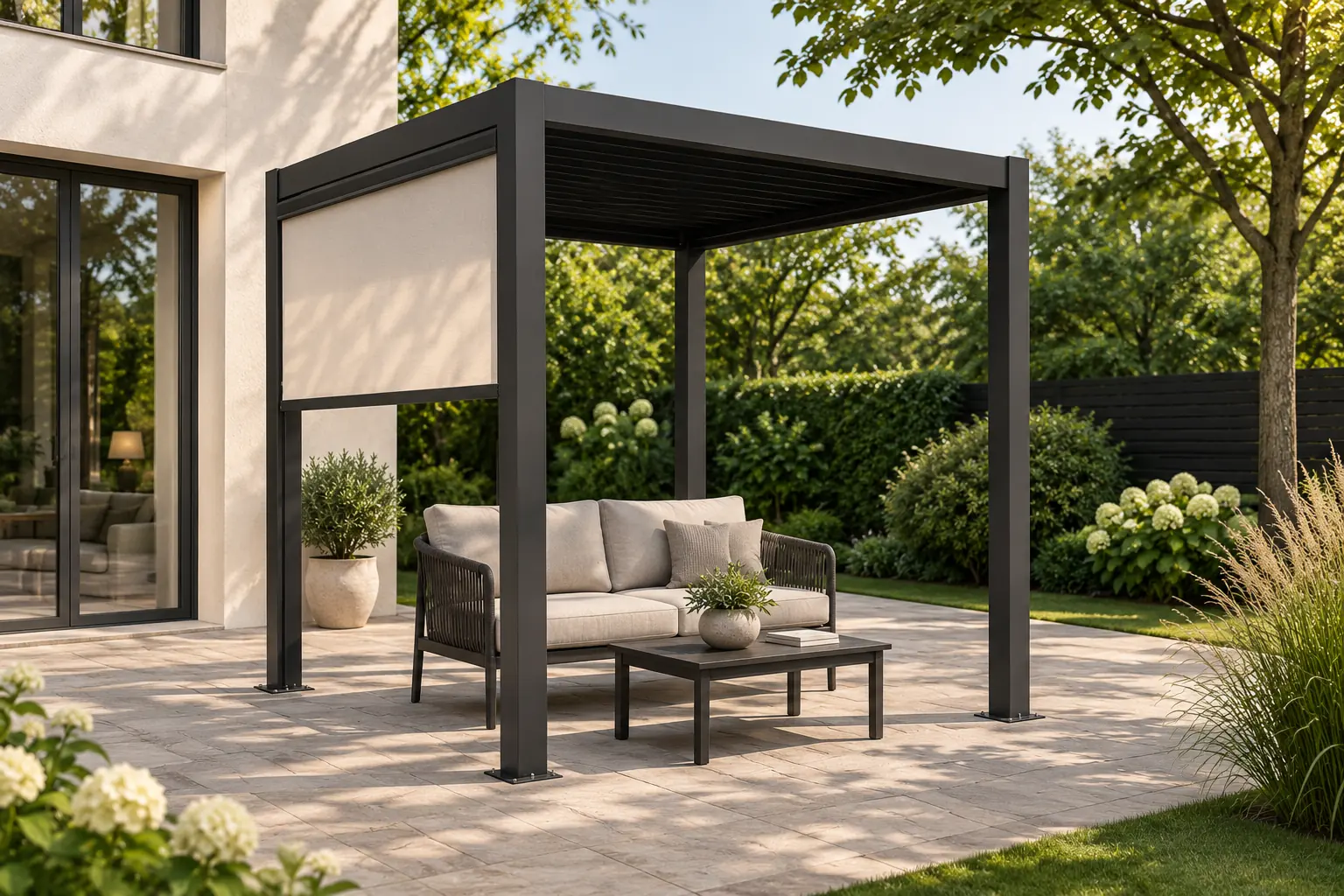
LERYOU’s side sun-screen layout, optional glass sides and net additions serve different purposes within a coordinated pergola configuration. The pergola’s manually adjustable louvred roof is a separate feature from the operating method chosen for a side element. A manual roof does not establish a motorised blind, shared remote control or automatic side operation.
The pergola side-screen configuration overview explains the available option types. Select the roof, side layout and operating method together while keeping each component’s purpose clear.
Keep an entrance and a service route working
Mark the route people normally take with food, cushions or gardening equipment. Test it with chairs pulled out and side elements in their intended positions. A fixed panel across that route has a different consequence from a retractable screen; sliding glass or slatted panels need room to travel and park.
Check that operating handles or controls remain reachable without moving furniture. For an electric system, agree the power and control requirements for that particular installation rather than assuming compatibility with the pergola roof controls.
At ground level, look for conflicts with drainage outlets, uneven paving and places where leaves collect. Screen guides and tracks need to be considered alongside the pergola’s water route. Keep access for cleaning the material, clearing the relevant channels and servicing moving parts. Follow the selected system’s care instructions and weather operating limits.
Bring the view and the measurements into one brief
Prepare the side layout, clear opening measurements, photographs of beams and posts, intended lighting and the normal entrance route. Add the material preference, desired operating method and the components you want included.
Discuss a pergola side-screen configuration with LERYOU around those requirements. The useful question is how the proposed side fits the structure and the way you use the space, rather than how many sides can be closed.
Frequently asked questions
Can I add a privacy screen to an existing pergola?
Possibly, depending on the frame, mounting surfaces and selected accessory. Compare the actual bay and fixing arrangement with the screen system rather than buying solely by nominal pergola size.
Will a screen labelled 3m fit every 3m pergola?
No. The label can identify a compatible product family or overall side size. Post spacing, beam profiles, mounting position and assembly dimensions still need to match.
Do pergola privacy screens work at night?
The result depends on the material, viewing direction and lighting. Check the selected screen with the intended evening lights on; mesh that reduces inward views in daylight may reveal more after dark.
Is clear glass a privacy option?
Clear glass preserves visibility through the side. Choose it for a layout where retaining views is useful, and consider visual screening separately where overlooking is the problem.
Which side should I screen first?
Identify the main unwanted sightline from the seating or standing position you use most. Prioritise that direction while keeping a convenient entrance and checking diagonal views around the screen edges.
Does a net screen make the pergola insect-proof?
Material alone does not close the whole space. The top, sides, lower edge, corners and entrance all affect the complete arrangement; choose the configuration around the intended function.
Are side screens supplied with the pergola?
They depend on the selected configuration. Compare the included side elements, mounting components and instructions separately from optional glass, net or sun-screen additions.
 English
 Deutsch
 Français
 Español
 Italiano
 Polski
 日本語
 한국어
 Nederlands
 Čeština
 Português do Brasil
 Русский
 ไทย
