
A barbecue storage cabinet earns its place when it makes an outdoor meal easier to set up and easier to put away. The useful question is not simply whether a cupboard fits beside the barbecue. It is whether you can take out a tray, open the side table and move between the cabinet and dining area without repeatedly rearranging the patio.
Choose around that sequence. Start with the belongings that need a home, then test the cabinet in three states: parked, open for retrieval and extended for serving. This approach makes dimensions, door arrangements and folding surfaces easier to compare.
Choose storage furniture for the task you actually have
A grill storage cabinet can describe several different products. A freestanding cupboard or preparation cart holds accessories and provides a nearby surface. An outdoor kitchen module may connect to other cabinets, a sink or an appliance housing. A built-in storage insert fits into a separate enclosure. These formats require different plans.
If the task is to organise tools, trays and tableware beside an existing cooking area, start with storage furniture. If the task involves installing a cooking appliance, choose the exact purpose-designed arrangement and follow that appliance’s installation instructions. A cabinet’s metal body does not decide appliance compatibility.
Write a short contents list before comparing products. Separate long tools, broad serving trays and small loose accessories. Add the items that return after the meal, not just the tidy collection shown before cooking. This gives the cupboard a practical job rather than making it a place for whatever will not fit elsewhere.
Check three states, not one rectangle
Mark the intended cabinet position on the patio. Use the following checks in order, with the same largest tray or storage container in mind throughout.
| Cabinet state | Space to examine | Practical test |
|---|---|---|
| Parked between uses | Closed body, handle, folded side table and nearby furniture | Can people use the normal route without brushing past the cabinet? |
| Open for retrieval | Door swing, standing position and the path of the item leaving the cupboard | Can the largest tray come out without moving a chair or lifting it over an obstruction? |
| Extended for serving | Side worktop, its supports and the route between storage and dining | Can someone use the surface while another person passes the cabinet? |
These checks overlap. A position that works with the doors closed can fail as soon as the side table is opened. Equally, a generous serving surface is less helpful if its support legs occupy the only place available for a chair. Keep the furniture plan visible while testing each state.
What the size means on a folding-table cabinet
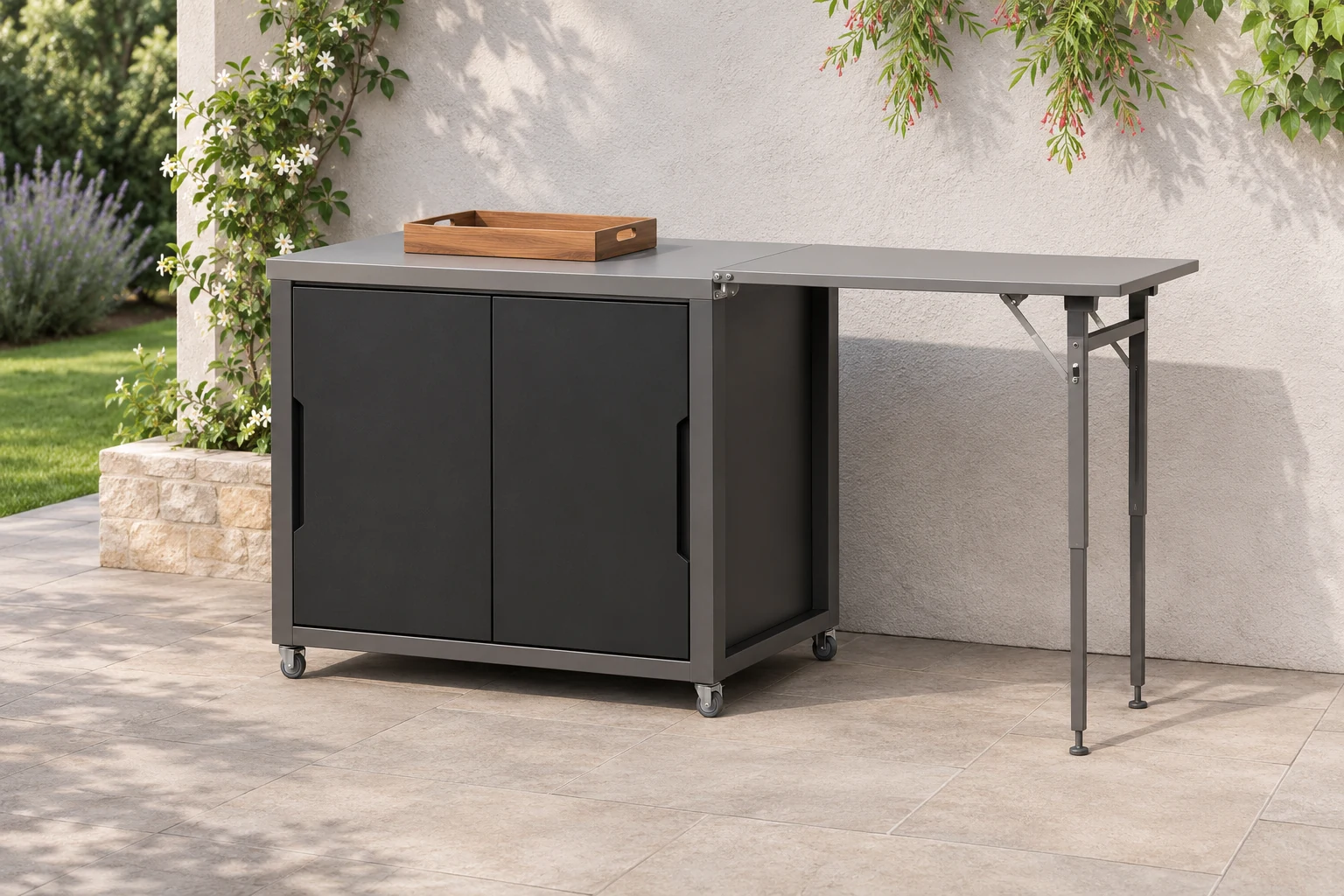
LERYOU’s barbecue storage cabinet with folding side table combines powder-coated steel construction, enclosed front-door storage, a handle and wheels. One size configuration is listed as 100 (+66) × 65 × 90 cm.
The extension notation matters: the 100 cm cabinet span plus the 66 cm side extension gives a listed extended span of 166 cm. That addition describes the length occupied by the opened furniture along the extension side. It does not add 66 cm to the enclosed cupboard, and it does not describe the full working area around the doors and the person using them.
Use the size to begin a layout, then check the selected configuration’s complete outline, including its handle and folded parts. Compare the clear door opening and interior separately. The outside dimensions cannot tell you whether a deep tray will pass the doorway or how an internal divider will affect its position.
Give the extension a job and a floor position
Decide what the folding surface will do during a meal. It might receive a tray taken from the cupboard, hold serving dishes or provide a clear place for setting out utensils. Choosing one main job helps prevent the extension becoming a permanent shelf for miscellaneous belongings.
On the illustrated design, the side table has supporting legs beneath its outer end. Plan that floor position along with the surface above it. A clear-looking space beneath a worktop is not automatically a place to tuck a chair, a large container or another wheeled item.
Try a simple sequence: open the cupboard, remove the tray, close the doors and place the tray on the side table. Then reverse it. If any step requires reaching around a support, stepping into the main walkway or moving the dining furniture, adjust the layout before choosing a larger cabinet.
Keep the folding action accessible too. A plant pot or nearby wall can leave enough room for the extended surface but obstruct the movement needed to open or close it. Check the product’s operating sequence as well as the final position.
Match the inside to how you retrieve things
Group belongings by the way you use them. A shallow container for small accessories can leave the cupboard in one movement, while long utensils need a clear route through the opening. Broad trays may need to be stored flat or on edge depending on their shape and the selected interior layout.
Measure the item at its widest point, including handles. Compare that measurement with the clear opening and the intended storage position. A container fitting behind closed doors does not guarantee that it will pass comfortably through one open door.
If the main need is storing tall garden supplies rather than creating a serving position, compare a separate format such as upright outdoor metal storage cabinets. Choose the furniture around its job; a taller cupboard and a worktop-height cart solve different access problems.
Compare materials and movement as separate choices
When comparing metal outdoor BBQ cabinets, identify the body material, its finish and the worktop material separately. Powder-coated steel construction is a useful description of this LERYOU cabinet’s body. The colour or appearance of a worktop should not be used to identify its material or decide how to use it.
Choose cleaning methods and protective arrangements from the selected product’s care instructions. Keep utensils and containers clean and dry before returning them to storage. Use appropriate boards or trays for food preparation, and keep cooking appliances on the installations intended for them.
A handle and wheels make repositioning part of the design, but the moving route and the working position need separate checks. Look for thresholds, paving joints and tight turns between the storage location and the patio. Confirm the wheel and holding arrangement for the configuration you select, then use the cabinet in a level, stable working position according to its instructions.
Finish the plan with a pack-away check
Imagine the end of the meal. The serving tray needs a destination, the doors need to open again and the side table needs room to fold. Leave that sequence possible without clearing the entire patio. A small cupboard that supports a tidy routine can be more useful than a larger one that obstructs everyday access.
Before choosing a configuration, bring together the contents list, the three-state layout and the required components. Specify the interior arrangement, worktop, folding supports, handle and wheels together. Check which fittings and accessories belong to the supplied package.
For this folding-table format, LERYOU offers size and colour options. Ask LERYOU about cabinet dimensions and configuration with your available space, largest stored items and intended side-table use so the discussion starts with the layout you need.
Frequently asked questions
What should a barbecue storage cabinet hold?
Plan around the tools, trays and accessories you actually use. Measure larger items and group small belongings into removable containers. Keep food storage and fuel requirements separate from ordinary furniture selection.
Does a folding side table increase cupboard capacity?
It adds an external working surface. It does not enlarge the enclosed storage compartment. Compare the internal layout and the extended furniture size as two separate features.
How much space should I leave in front of the doors?
Check the selected doors’ full swing, a comfortable standing position and the path of the largest item being removed. Test this with nearby chairs in their normal positions rather than relying on a single general clearance figure.
Is a grill storage cabinet a built-in grill housing?
The term can refer to different products. Identify whether you need accessory storage or a purpose-designed appliance installation. Follow the exact appliance and enclosure instructions when planning a built-in arrangement.
Can any enclosed cabinet be used for gas cylinders?
Choose purpose-designed cylinder storage and follow its specific instructions. General enclosed accessory storage and specialist fuel storage serve different requirements.
Do wheels replace the need to plan a working position?
No. Wheels help with relocation, while working requires the specified stable position and holding arrangement. Check both the route used to move the cabinet and the location used for serving.
What should I confirm before choosing a cabinet?
Confirm the outside size, clear opening, interior arrangement, folded and extended layout, worktop material, supports, wheel arrangement and supplied components. Match each to the same contents list and patio plan.
 English
 Deutsch
 Français
 Español
 Italiano
 Polski
 日本語
 한국어
 Nederlands
 Čeština
 Português do Brasil
 Русский
 ไทย
