
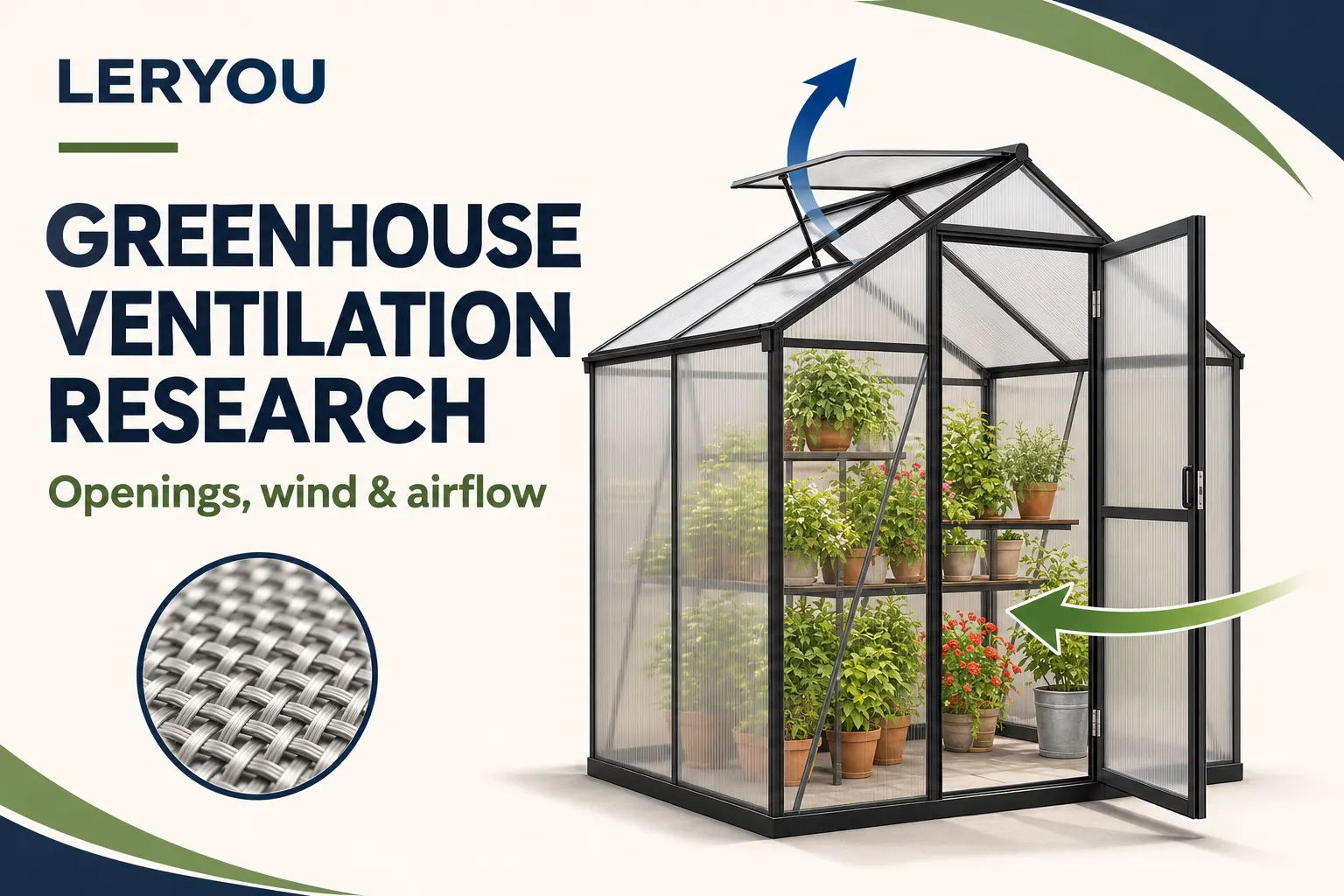
Greenhouse ventilation starts with openings, but its effect depends on the route connecting them. Wind, the temperature difference between indoors and outdoors, the shape of an opening and resistance along the way all influence how air moves.
For a small growing enclosure, that changes the useful question. Instead of counting windows, follow the journey from outdoor air to the plants and back outside. Two original studies, published in 2005 and 2016, explain why opening arrangements and insect screens deserve attention. Read together, they offer a way to examine a greenhouse as a working system.
Start by separating air exchange from air movement
Ventilation replaces indoor air with outdoor air. A circulating fan moves air around inside. These can work together, but movement near a plant does not by itself show how much fresh air is entering the whole structure.
Natural ventilation uses pressure differences created by wind and by warmer, less-dense air rising. Lower and higher openings can provide a route for buoyancy-driven exchange. Wind adds another influence: its speed and direction change the pressure around the building, so an opening’s role can change with the weather.
This is why a drawing of arrows is useful for planning, while the greenhouse still needs attention in use. Look at the complete route and the conditions around it, including nearby fences, walls, dense planting and the openings you can operate together.
What a screened-greenhouse experiment found about openings
In Liu and colleagues’ 2005 study in the Journal of Zhejiang University Science B, researchers combined measurements with a temperature model for a three-span, polyethylene-covered greenhouse at Zhejiang University. The experimental structure covered 504 m², had insect-proof screens and contained no crop during the measurements.
The team compared roof-only ventilation with roof-and-side ventilation over ten test days. Under the conditions analysed, adding the side openings changed the ventilation response and reduced the steady indoor-to-outdoor temperature difference compared with roof-only operation. The analysis also examined changes in opening height and wind speed.
The important finding is a relationship: openings work in combination with the forces driving air through them. A high opening and an accessible lower opening can create a different route from roof openings alone. The result belongs to the studied structure, screens and weather; it is not a temperature forecast for a garden greenhouse.
For small greenhouse ventilation, use that relationship to examine the actual layout. Where can air enter when the roof window is open? Can that lower opening remain usable when plants, trays and tools are in place? What happens to the arrangement when the entrance has to be closed?
Why similar-looking insect screens can behave differently
A second study makes the air route more concrete. In López and colleagues’ 2016 University of Almería research, published in Sensors, three insect-proof screens underwent geometric examination and low-speed wind-tunnel testing. Researchers then examined conditions inside an empty Mediterranean greenhouse divided into two sectors.
The greenhouse measured 24 × 45 m and had three roof vents. Field observations took place on 5–8 August 2014. Two screens were compared in the separate sectors during the first two days; a third screen was installed in both sectors for the next two days.
Two of the tested screens had similar thread densities and porosities of 35% and 36%, yet their aerodynamic behaviour differed. Thread geometry and screen thickness helped explain why a similar proportion of open area did not produce the same resistance to airflow. In the greenhouse observations, more permeable screening was associated with higher air velocity at the measured central positions.
That provides a better screen-selection question than simply asking whether mesh looks fine or coarse. Consider its pressure-drop or permeability information alongside the opening it covers. Pest exclusion and airflow are separate properties to assess. The study’s local air-velocity observations also describe a different measurement from a complete air-change rate.
Turn the research into a three-part layout review
For hobby greenhouse ventilation, an effective review can be simple: trace the route, inspect the operating space and repeat the check with the greenhouse occupied. Each pass answers a different question.
| Review | What to examine | Useful outcome |
|---|---|---|
| Air route | Available lower openings, roof windows, screens and surrounding obstructions | A plan showing which openings work together |
| Operating space | Door swing, window movement and access to handles or stays | An arrangement you can open, adjust and close comfortably |
| Occupied layout | Bench positions, taller plants, trays and the entrance route | A growing plan that preserves access to the ventilation controls |
The occupied review matters because greenhouse use changes through the season. A clear early-spring bench may later hold taller plants. Draw their expected position before placing staging directly under a window control or filling the entrance with pots. Keep a practical route for tending plants as well as a route for air.
How real product details change the plan
De LERYOU compact polycarbonate greenhouse with adjustable windows combines an aluminium frame, polycarbonate panels and hinged-door access. These features give the layout review specific objects to work with: an opening window to operate, a door that needs swing clearance and growing space to arrange around both.
Place the door’s swing on the garden plan before placing a potting bench or a large container outside it. Inside, keep the approach to the window control clear. This connects two everyday tasks that are often considered separately: reaching plants and operating the enclosure.
El freestanding polycarbonate greenhouse with roof vents has an apex-roof format and front hinged access. Compare the roof-opening positions with the entrance and the intended staging layout. Roof height, window placement and reachable controls belong on the same sketch.
LERYOU’s standard greenhouse range also lists 4 mm twin-wall polycarbonate and 1.8 mm solid polycarbonate panel options. These are different panel constructions, not alternative descriptions of ventilation capacity. Choose the panel construction and review the openings as separate parts of the configuration; panel thickness does not tell you the clear area of an open window.
Observe conditions where the plants are
After setting up the layout, monitor conditions at plant height and compare different parts of the growing area. Note which openings are in use and whether the day is still or windy. That makes a warm corner more useful information than a single reading without context.
Also distinguish reducing incoming solar heat from removing heat through air exchange. Shading changes the heat entering the enclosure, while ventilation exchanges indoor and outdoor air. Their roles complement each other. Changing a roof opening cannot resolve every combination of strong sunshine, warm outdoor air and dense planting.
Preguntas frecuentes
What is the best natural ventilation arrangement?
Assess the available openings as a connected route. Roof and lower openings can work together, while wind, opening geometry and screens affect the result. Choose around the actual structure, site and growing layout.
Is opening the greenhouse door enough?
An open door can contribute to air exchange, but its effect depends on the other openings and outdoor conditions. Include the door in the airflow plan while keeping access and safe operation practical.
Does insect mesh reduce airflow?
Mesh introduces resistance. The Almería study shows why similar porosity or thread density can conceal different aerodynamic behaviour. Compare the particular screen’s airflow information rather than assigning every mesh the same reduction.
Does a circulation fan replace ventilation?
A fan moving indoor air can help distribute it around plants. Fresh-air exchange still requires a route between indoors and outdoors. Distinguish circulation equipment from an extraction-and-inlet arrangement.
Why does the same greenhouse behave differently on still days?
Wind-driven pressure changes when the weather changes. Buoyancy depends on temperature differences and opening arrangement, so the forces available on a still day differ from those in a breeze.
Can I choose ventilation from panel thickness?
No. Panel construction describes the enclosure material. Ventilation assessment also needs the opening positions, clear apertures, operating method and any screening.
How should I plan staging near an opening?
Allow room for the window or door to move and for you to reach its control. Check the layout with plants at their expected later-season size, not only with empty staging.
Bring the openings and growing layout into one discussion
Make a sketch showing the site, doorway, roof windows, staging and taller plants. Add how you expect to operate the greenhouse day to day. You can discuss a greenhouse configuration with LERYOU using that plan, so the conversation starts with the openings and space your growing routine needs.



 English
 Deutsch
 Français
 Español
 Italiano
 Polski
 日本語
 한국어
 Nederlands
 Čeština
 Português do Brasil
 Русский
 ไทย
