
Choosing between glass and polycarbonate greenhouse glazing starts with a practical question: what conditions do you want to create for your plants? Warmth overnight, useful daylight and manageable daytime temperatures all matter. A material name alone cannot describe that balance.
Research offers a better way to read glazing comparisons. Look at the actual construction, the conditions during measurement and the outcome being reported. An indoor temperature, a light-transmission percentage and a heating-energy figure answer different questions.
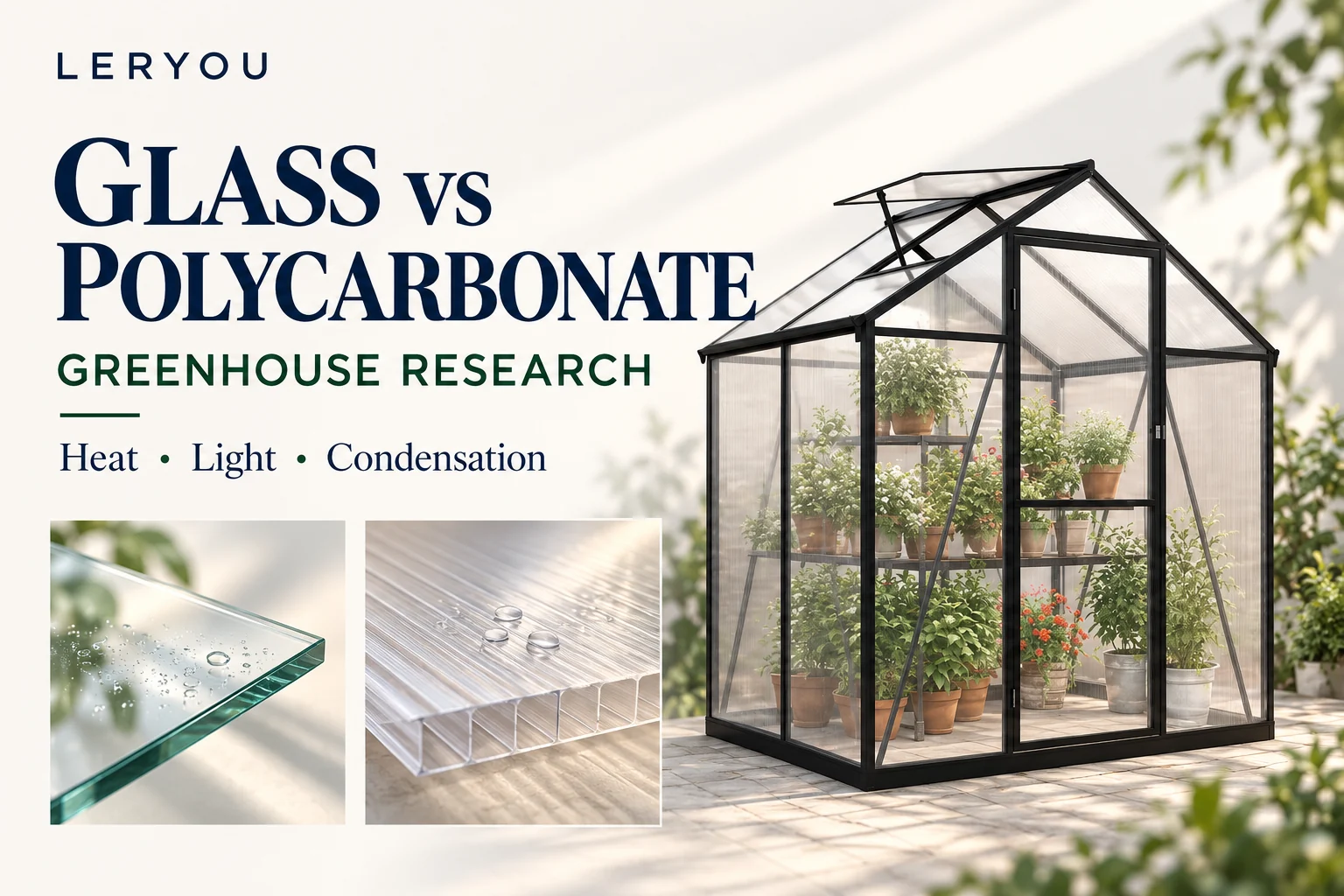
What a direct greenhouse comparison measured
A 2022 study by Kim and colleagues at South Korea’s Rural Development Administration and Jeonbuk National University compared three 18 m² greenhouses. The glass and polycarbonate houses used 4 mm and 6 mm coverings respectively. Measurements covered three clear two-day periods in October 2019, with no crops, ventilation, active heating or cooling. The authors combined the observations into an average daily profile.
| Reported indoor air temperature | 6 mm polycarbonate house | 4 mm glass house |
|---|---|---|
| Minimum | 12.0°C | 10.6°C |
| Maximum | 46.9°C | 43.7°C |
The polycarbonate house had a higher minimum, while the glass house had a lower peak. These results describe the tested closed houses. They do not establish a fixed temperature advantage for every greenhouse or a percentage saving on a heating bill: neither house was actively heated during the comparison.
For someone planning a growing space, this changes the next question. Instead of asking only which panel holds warmth, ask how the complete greenhouse will handle both the coldest part of the night and a sunny afternoon. Keeping warmth and releasing excess heat belong in the same plan.
Why dry light-transmission figures are incomplete
A 2017 Wageningen Plant Research report by Swinkels, van Breugel and Tsafaras examined condensation and light transmission using eight glass materials. Its method reproduced natural condensation on inclined samples so that water could drain.
The clear reference sample lost 3.0 percentage points of hemispherical light transmission. The six diffuse glass types varied from a 0.9-point reduction to a 1.5-point increase. Surface structure and treatment affected the response, so diffuse glass did not behave uniformly. These were glass-sample measurements, rather than a polycarbonate comparison or a measurement of crop yield.
This makes the wet condition a useful part of a glazing discussion. Ask whether a quoted transmission figure describes a clean, dry sample or includes condensation. Compare values measured in the same way before deciding which figure is relevant to your growing space.
Separate the measurements before comparing panels
Light transmission and light diffusion
Transmission describes how much light passes through. Diffusion describes how that light is scattered. A panel can spread light while transmitting a different total amount from another panel. Clear appearance alone does not supply either measurement.
Check which light range the figure covers: visible light, photosynthetically active radiation, or broader solar radiation. Then check the measurement angle and whether it concerns the panel alone or the assembled roof. A single percentage without those details is difficult to compare.
Thermal conductivity and U-value
Thermal conductivity concerns conduction through a material. A panel U-value describes heat transfer through a specified construction under stated conditions. They use different units and should not be placed in the same comparison column.
For a glazing quotation, identify the panel thickness, wall arrangement, air spaces and any surface treatment alongside the thermal value. For a greenhouse energy estimate, also define the frame, joints, ventilation and heating schedule. Ask what boundary the calculation covers before applying it to the whole structure.
Air temperature and purchased heating energy
A thermometer tells you about air conditions at its measuring position and time. An energy comparison needs a defined temperature target, operating period and heating input. Fuel or electricity consumption should be reported separately from changes in temperature.
If you intend to heat a greenhouse, make the target temperature and season explicit. If you intend to use it unheated, focus the comparison on your growing calendar, available daylight and how you will monitor and manage conditions.
Compare the complete glazing arrangement
Start with a drawing that identifies roof and wall materials separately. A clear sidewall and a translucent roof can belong to the same greenhouse. The word “polycarbonate” also needs a construction description, such as solid or twin-wall; the word “glass” needs its specified type.
LERYOU offers polycarbonate greenhouses with aluminium frames and glass greenhouse configurations. Compare the selected model’s roof, walls, vents and glazing specification together. Identify which panels cover the roof and which form the walls before comparing the available options.
- Growing task: record the plants, season of use and whether heating is planned.
- Site: review sunlight, surrounding shade, working space and exposure.
- Glazing: identify roof and wall construction, thickness and surface treatment.
- Evidence: compare optical and thermal values with matching definitions and conditions.
- Operation: plan access, ventilation, cleaning and replacement-panel availability.
Keep ventilation accessible as the plants grow and shelves fill. Consider the position of roof vents and doors, together with any planned shading. Our greenhouse ventilation guide helps you review these parts of the arrangement.
Frequently asked questions
Is glass or polycarbonate better for a greenhouse?
Choose a specified glazing arrangement around your growing task, site and operating plan. Compare the light and thermal evidence, access, ventilation and maintenance together. A universal material winner is less useful than a clear match between the greenhouse and how you will use it.
Does a warmer greenhouse prove lower heating costs?
No. A temperature reading does not measure purchased energy. A useful cost comparison needs the same temperature target, a defined weather period and an identified heating system, together with energy consumption and energy prices.
Does glass always transmit more useful light?
Compare the actual products using the same light range and measurement method. Construction, surface treatment and wet or dry conditions need to be identified. The useful question is what the stated figure measures and how it relates to your growing conditions.
Does polycarbonate eliminate condensation?
A material name does not establish that a surface stays dry. Review the panel’s documented surface treatment, installation orientation and moisture-management details. Keep water on the inner surface separate from moisture inside hollow panel channels.
Is diffuse glazing the same as shading?
Diffusion describes the scattering of light. Shading concerns reducing incoming radiation. Check the particular panel’s transmission and diffusion information alongside any separate shading arrangement; one label does not describe both functions.
Can glazing replace summer ventilation?
Plan glazing and ventilation together. Review how doors and vents operate, how you will monitor temperature, and when shading may be useful. Select controls and operating arrangements for the plants and season you have planned.
What should I compare before selecting a model?
Request the roof and wall specifications, panel construction, dimensions, opening arrangement, installation requirements and care instructions. Add any documented optical or thermal data relevant to your use. Keep model-specific facts together so you can compare complete configurations.
Choose glazing around your growing conditions
Bring your site dimensions, growing season, plant needs and preferred glazing arrangement into one brief. Contact LERYOU to discuss greenhouse configurations and the product information needed for your comparison.


 English
 Deutsch
 Français
 Español
 Italiano
 Polski
 日本語
 한국어
 Nederlands
 Čeština
 Português do Brasil
 Русский
 ไทย
