
A bike storage box needs to work with your bicycles and the space around them. The outside dimensions help you mark its position in the garden, but the usable interior, door opening and fully raised lid determine whether putting a bike away will be straightforward.
Start with the bikes you actually use. Include handlebars, baskets, child seats and other fitted equipment, then plan the route from the garden entrance to the storage position. This guide explains what to compare before choosing an outdoor enclosure.
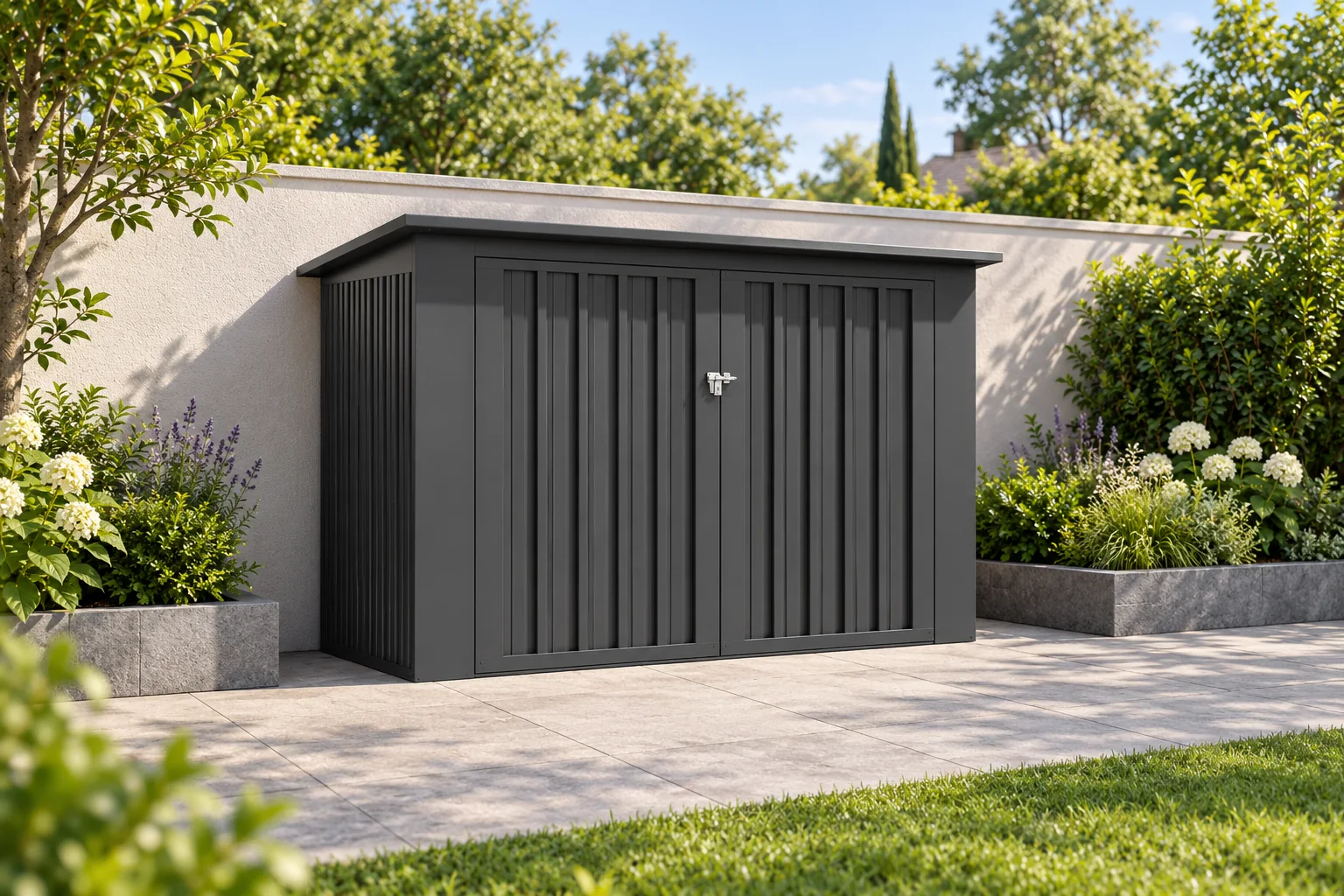
Choose the enclosure format before comparing capacity
A bicycle storage box usually describes a compact enclosure, but the name is also used for folding-bike transport containers. For garden storage, check that the product is intended to stand outdoors and that its access arrangement suits a complete bicycle. A travel case and an outdoor enclosure solve different problems.
| Format | What to compare | Access question |
|---|---|---|
| Low enclosed box | Usable interior and the complete opening movement | Does the lid need space above or behind the unit? |
| Upright bicycle shed | Floor layout, door opening and internal height | Can the bicycle pass through and turn into its parking position? |
| Open or partly enclosed shelter | Covered area and the actual enclosure or locking provision | Which sides remain exposed and what, if anything, locks? |
Low height can help a box sit comfortably in a garden setting. It does not establish the open height, the number of bikes that fit or the level of protection. Compare the drawing and operating sequence rather than treating all low stores as the same design.
Measure the bicycles before measuring the box
Record the overall length from the frontmost to the rearmost point, the widest part of the handlebars or accessories, and the highest fitted part. Include a basket, rack bag or child seat if you plan to leave it attached. Check each bicycle separately; a shared wheel size does not establish matching overall dimensions.
Then compare three different sets of product measurements. Outside dimensions describe the space occupied by the enclosure. Interior dimensions describe the room behind the walls and frame. The clear opening describes the route through the doors, including any threshold, centre post or fittings that reduce access.
A bicycle can fit inside a rectangle on a drawing yet be awkward to manoeuvre through its entrance. Review the approach angle and the space for turning the handlebars. For a heavier bicycle, pay particular attention to whether the route involves lifting over a threshold or moving it sideways.
Plan how individual bikes will come out
An advertised bicycle count is a starting point for comparison. Handlebar overlap, pedals, baskets and the parking arrangement affect how that space works. Ask for the layout used to demonstrate the stated count and compare it with your own bicycles.
Think about the bike used most often. Can it leave while the others remain parked, or must another bicycle be moved first? A wide opening can make loading easier without guaranteeing independent access to every position. Allow space for cycling accessories without placing them in the wheel route or against the latch.
If a track, rack or wheel holder is shown, check whether it belongs to the selected configuration and whether it is supplied. A photograph of a different model does not establish the layout of the box you are comparing.
Check the complete lid and door movement
A closed box height is different from the space needed to open it. Request the fully raised height and any rear or side clearance for a lift-up lid. Check nearby window ledges, wall lights, branches, shelves and fence caps. Mark the operating space as well as the closed footprint.
For front doors, review how far each leaf swings and where you stand while opening it. Include the space needed to hold and guide a bicycle. A narrow path may accommodate the box but leave too little working room in front of it.
Lid assistance and access details vary by model. LERYOU’s bicycle storage range includes enclosed metal box configurations with ribbed panels, front-opening doors and a gas-spring-assisted lid. Compare the chosen box’s opening arrangement separately from the open-front shelters and other formats in the range.
Review the site, support and fixing requirements
Check the route to the installation position as well as the final site. Record gates, steps, tight turns and any obstructions that affect delivery or assembly. Decide where you will stand when parking a bicycle and how the doors or lid interact with the boundary.
Use the selected model’s installation instructions to establish the required support surface, base area and fixing arrangement. Confirm whether a floor or base is included, whether site preparation is separate and which fixings match the specified surface. Do not assume a concrete base or a particular anchor kit is universal.
Review local siting requirements where relevant, particularly for a front garden or restricted property. A low-profile design does not by itself establish that permission is unnecessary. Resolve placement and installation requirements before ordering.
Separate rain protection, moisture and security
Read the exact model’s outdoor exposure and care information. Roof overlaps, joints and door edges are useful construction details to inspect, but appearance alone does not establish a waterproof rating. Rain reaching the enclosure and moisture already inside it are separate questions.
Let wet equipment dry where practical before closing it away, keep any specified ventilation openings clear and follow the care instructions for the selected finish and fittings. Ventilation provision is part of a product’s design; do not assume a box has it or alter panels to add it without the manufacturer’s approval.
For locking, identify the supplied latch, lock or padlock provision and how it operates with the doors closed. Lockable describes an access feature. If a security grade is important, verify the certificate for the exact enclosure and configuration, and check any insurer requirements separately. A rating associated with another model or brand does not establish this box’s security.
Frequently asked questions
What size bicycle storage box do I need?
Measure each bicycle with the accessories you intend to leave attached. Compare usable interior dimensions, the clear opening and the route into the parking position. Add the operating clearance for doors and lid to the site plan.
Can I rely on the advertised number of bicycles?
Check the stated layout and the bicycles used to establish it. Your handlebar widths, pedals and accessories may change both the fit and the ability to remove one bicycle while others remain parked.
How much room is needed above a lift-up box?
Use the fully open height and rear-clearance dimensions for the selected model. The closed height is insufficient. Check the entire lid movement against nearby walls, ledges, planting and overhead obstructions.
Is an outdoor bicycle storage box waterproof?
Review the model-specific rain-protection information and exposure limits. Check moisture management separately: keeping rain outside does not establish that damp equipment or humid air inside will stay dry.
Does every bike box include a floor and anchors?
No single package applies to every design. Confirm the floor or base scope, installation surface, fixing requirements and included hardware in the selected product documentation.
Can an electric bicycle fit in the same box?
Compare the actual bicycle dimensions, accessories, weight-handling needs and access route. The term e-bike does not establish fit. Suitability for storage also does not establish that charging equipment or a charging installation is provided.
Is a low box better than a taller shed?
Choose around the bicycles, the site and the way you retrieve them. Compare the usable layout and full opening movement. A taller enclosure may offer a different access arrangement, while a low box may suit the available garden position.
Bring the bike measurements and site plan together
Prepare one comparison sheet with the bicycles, proposed footprint, clear opening, lid movement, parking layout and installation scope. Contact LERYOU to discuss bicycle storage configurations and the model information needed to review your space and access requirements.
 English
 Deutsch
 Français
 Español
 Italiano
 Polski
 日本語
 한국어
 Nederlands
 Čeština
 Português do Brasil
 Русский
 ไทย
