
An elevated planter has to work twice: first as a container for roots, then as a place you can comfortably tend. When comparing raised planter boxes on legs for sale, a photograph of an empty box only answers part of the question. Add plants, a watering can and the space for your hands, and the layout becomes much more revealing.
Start with what will grow inside, then rehearse how you will reach it and care for it. This guide explains how to compare elevated garden boxes without confusing overall height with planting depth, or a useful storage shelf with extra growing capacity.
Make sure the box matches the growing task
Similar names can describe quite different products. For planting above a paved surface, look at the container’s bottom and supporting legs, rather than relying on the word “raised”. A tall frame around garden soil is a different arrangement.
| Format | Where planting happens | What to compare |
|---|---|---|
| Elevated planting box | Within a supported container above the ground | Internal root space, bottom construction and access |
| Open-bottom raised bed | Inside a frame placed on the ground | Site, soil arrangement and bed access |
| Potting bench or plant stand | Usually in separate pots or trays | Work surface or the containers it supports |
A decorative planter on a stand may suit a single display, while a long trough gives you a different planting layout. Decide whether you want a growing container or somewhere to arrange existing pots. You can also compare LERYOU’s nursery and growing formats before committing space to one arrangement.
Read the dimensions in the right order
Begin with usable internal length, width and depth. Match these to the plants you intend to grow and their spacing requirements. Then examine the overall height and footprint. Legs can raise the container without giving roots any more room.
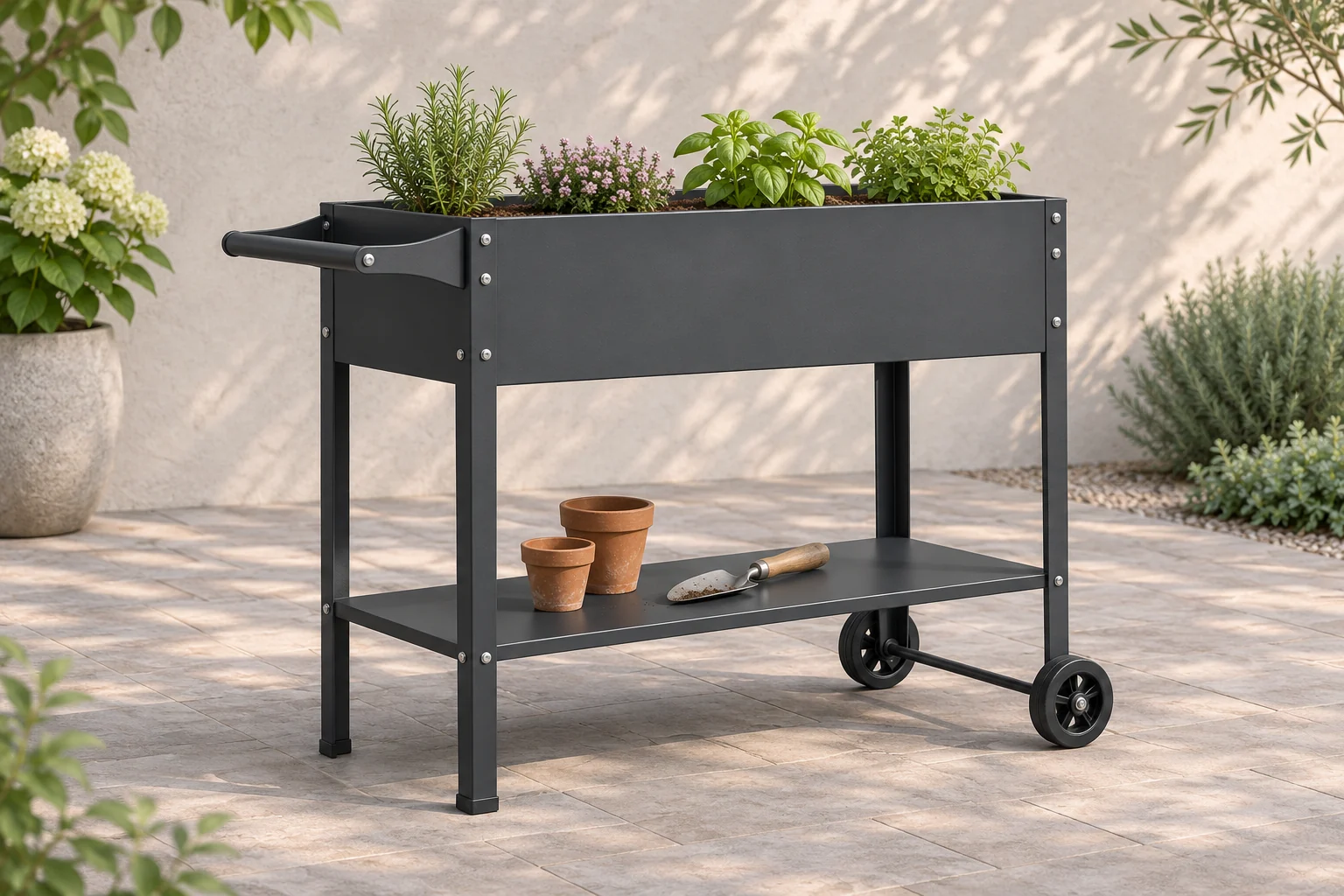
For a concrete example, LERYOU’s rectangular colour-coated steel planter with a lower shelf has an overall size of 120 × 50 × 80 cm. These external dimensions describe the assembled item. They provide a starting point for laying out a patio, while the planting compartment needs its own internal measurements.
| Published external measurement | Useful planning check |
|---|---|
| 120 cm overall length | Mark the long side, then allow for end access and the handle |
| 50 cm overall width | Check the available position and reach across the container |
| 80 cm overall height | Compare the top edge with your intended working position |
| 0.60 m² nominal external rectangle | Use 1.20 × 0.50 m for initial placement planning |
That 0.60 m² rectangle is an external planning figure, rather than usable planting area or the full space needed to work. Do not calculate soil volume by multiplying all three overall dimensions: much of the height belongs to the supporting structure. Use the planting compartment’s internal dimensions and intended filling level instead.
Rehearse reach with plants in place
Mark the proposed position and imagine tending the far corner. Can you get close enough to plant, water and remove a tired plant without stretching over the front row? Repeat the check with a watering can in your hand. The approach you use when carrying something can differ from the position you take with both hands free.
A wall-side location can save circulation space behind a planter, but it also makes the growing area accessible mainly from the front and ends. If the centre is difficult to reach, compare a different placement or a narrower container before choosing plants. Height alone does not establish comfortable standing or seated access.
Think ahead to mature foliage, too. Leave a practical approach to the plants that need frequent attention. A neat empty trough can become awkward if its most frequently tended section sits behind a taller planting group.
Give each storage feature a job
A lower shelf is most useful when it holds things you return there during normal care. In the LERYOU layout, the shelf sits beneath the planting box between the legs. It gives hand tools and spare pots a separate place, keeping storage out of the root compartment.
Test retrieval as well as storage. A pot might fit on the shelf but still be awkward to lift out beside a wall or through a crowded front edge. Choose which side you will approach, then check the height and movement of the actual watering can or pots you want to keep there. Leave room for your feet as you work at the trough.
This makes the shelf part of a simple care routine: take out the tool, tend the plants, return it without moving several other items. Its value comes from accessible storage, not from adding soil depth. The LERYOU elevated metal planter layout shows how the trough, legs, shelf and end fittings work together.
Settle the watering and moving routine before filling
Plan the final working position before adding growing medium. Check where you will stand to water, where excess water leaves the selected container and whether the surface below remains accessible for cleaning. Keep the water route separate from stored items and the path people use past the planter.
On the illustrated LERYOU unit, a pair of wheels supports one short end. A handle projects from the other end above two stationary feet. This is a different handling arrangement from a trolley supported on four castors. Match any planned movement to the supplied handling instructions and permitted loading.
Walk the route while the planter is empty: doorways, paving changes and corners can determine whether repositioning is practical. Choose a sensible regular watering position rather than making routine care depend on moving a filled container. Keep access to the handle available after you place pots on the shelf.
Check the complete growing setup
Compare the container bottom, drainage arrangement and any liner as separate parts of the growing setup. Use the arrangement specified for the chosen planter; a fabric liner retains growing medium but does not replace a structural base.
For a metal box, read the material and finish description precisely. Colour-coated steel describes the construction and finish of this LERYOU example. Review the intended planting use and care instructions alongside it, rather than treating the finish name as a promise about every growing medium or outdoor condition.
Before comparing offers, put the same items on each list: planting box, supporting legs, shelf, wheel and handle components, assembly fittings, bottom parts and any liner. Keep decorative pots, plants and tools separate. A clear component list makes a price comparison more useful than comparing photographs with different accessories.
Frequently asked questions
Are elevated garden boxes the same as raised beds?
The terms overlap in product listings. An elevated box supports its planting compartment above ground; an open-bottom raised bed surrounds a growing area at ground level. Check the bottom and supports.
Does an 80 cm planter give plants 80 cm of root depth?
No. Overall height includes the legs and structure. Choose plants and calculate filling needs from usable internal planting dimensions.
Can I use 0.60 m² as the growing area?
For the 120 × 50 cm external footprint, 0.60 m² is the nominal outside rectangle. Internal planting area and the surrounding working space are separate measurements.
Is a lower shelf useful on an elevated outdoor planter?
It can keep spare pots and hand tools near the growing area. Check access with the actual items and leave a comfortable standing position beside the box.
Can a planter with two wheels be moved when full?
Follow the loading and handling instructions for that configuration. Check the handle, stationary feet and intended route before making movement part of your care routine.
What should I check about drainage?
Check how water exits the container, how the growing medium is retained and where the outlet discharges. Keep the specified water route accessible for maintenance.
How do I choose between an elevated planter and a potting bench?
Choose a planter for growing within its supported container. Choose a potting bench when the main task is handling separate pots and trays on a work surface.
Bring the planting plan to the product conversation
Start with the available space, intended plants and the way you want to tend them. Then compare internal root room, access and the complete component package. To discuss LERYOU’s metal planter configuration, ask for planting dimensions and component details with your proposed layout.
 English
 Deutsch
 Français
 Español
 Italiano
 Polski
 日本語
 한국어
 Nederlands
 Čeština
 Português do Brasil
 Русский
 ไทย
