
DIY gardening products for retailers should be planned as a sellable range, not as a collection of unrelated outdoor items. For importers, distributors, retail chains and private-label brands, the commercial questions are practical: Which product families match the target channel? How easy is the product to assemble? What must be confirmed before packaging, labeling and quotation?
This buyer guide explains how to organize a DIY garden assortment around garden sheds, greenhouses, outdoor storage and outdoor living products. It also provides a supplier-review and RFQ checklist. Exact materials, dimensions, packaging and production arrangements must still be confirmed for the selected product and destination market.

Buyer summary: decide these five points first
- Target customer and channel: home-improvement retail, garden center, ecommerce, wholesale distribution or private label.
- Famille de produits : storage, growing, outdoor organization or outdoor living.
- Assembly expectation: component count, tools, instructions, access and realistic installation conditions.
- Commercial configuration: material, size, finish, accessories, branding and packaging requirements.
- RFQ inputs: target market, expected quantity, destination, channel and required documents.
Which DIY gardening products fit a retail range?
A useful assortment starts with the customer problem the product solves. A garden shed serves larger storage needs; a greenhouse supports protected growing; a metal box or cabinet offers compact organization; and a pergola or patio-cover product belongs to an outdoor-living project. Keeping these jobs clear helps buyers avoid overlapping listings and makes product comparison easier.
| Gamme de produits | Typical retail role | Information to confirm | Explore the range |
|---|---|---|---|
| Garden sheds | Storage for tools, bicycles and garden equipment in multiple footprint and roof directions. | External and internal dimensions, door access, panel construction, base requirements, finish, accessories and package count. | Solutions pour abris de jardin |
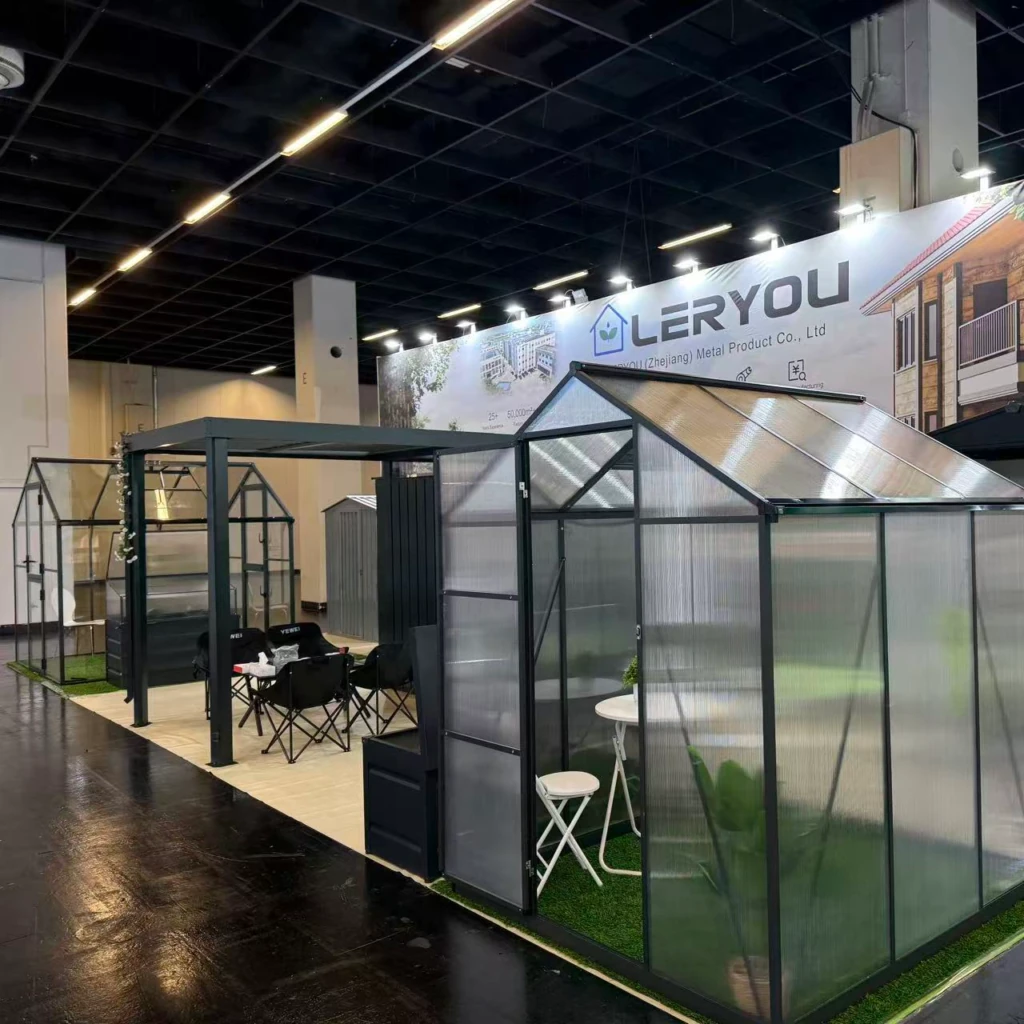
| Greenhouses and growing products | Seasonal or year-round growing ranges for garden centers, ecommerce and home-improvement channels. | Frame and panel configuration, ventilation, doors, anchoring context, accessories, packaging and market-specific requirements. | Solutions pour les serres et la culture |
| Stockage en extérieur | Compact storage paths such as bike storage, bin storage, metal boxes and outdoor cabinets. | Stored-item dimensions, lid or door operation, usable capacity direction, outdoor placement, security options and packaging. | Solutions de rangement d'extérieur |
| La vie en plein air | Project-led products such as pergolas, patio covers, gazebos and sunroom-related systems. | Site context, footprint, structural configuration, roof and side options, installation responsibility and required local review. | Solutions pour l'aménagement extérieur |
What “easy assembly” should mean to a retail buyer
“Easy assembly” should not be treated as a slogan. The buyer needs evidence that the product, instructions and packaging work together. Assembly also depends on product size, installer experience, site preparation and local conditions, so the supplier should avoid using one universal installation claim across an entire range.
- Ask whether parts are identified consistently across the packing list, manual and component labels.
- Review the assembly sequence, tool requirements and the points where two people may be needed.
- Confirm that holes, fasteners, panels, doors and accessories correspond to the selected configuration.
- Check how installation limitations, base preparation and anchoring requirements are communicated.
- Request a sample manual or assembly review before approving retail packaging.
- Confirm how missing-part and after-sales cases will be identified and handled.
Packaging and after-sales readiness matter as much as the product
A product can be suitable for the end user but unsuitable for a retail program if packaging, labeling and replacement-part information are not prepared for the sales channel. Ecommerce may place greater emphasis on parcel handling and clear product identification, while store-based retail may need display-friendly information and consistent carton labeling.
Packaging questions for the supplier
- How many cartons are used for the selected product, and how are they identified as one set?
- Which protective materials and internal supports are used for the approved configuration?
- Can the carton artwork, logo, label language and instruction format be reviewed before production?
- How are hardware packs, accessories and manuals separated and checked?
- What packaging information is available for loading and channel planning?
Planning a retail or private-label garden range?
Send LERYOU the target product family, destination market, sales channel, expected quantity and required customization. The team can then review the request against the relevant product and manufacturing information before quotation.
How to evaluate a DIY garden product supplier
The supplier review should connect sales promises with documents and repeatable order execution. Start with the actual product family, then verify which development, production, quality-control, packaging and export-support steps apply to that product. LERYOU’s manufacturing and customization capabilities page explains the company-level workflow; the final scope still needs to be confirmed for each project.
- Product evidence: drawings, specification sheets, available images and the relationship between variants.
- Customization boundary: what can be adjusted in size, material, color, finish, accessories, logo, labels or packaging.
- Quality plan: which incoming, in-process, finished-product and packaging checks apply.
- Sample approval: how differences between sample, approved specification and production order are controlled.
- Export coordination: documents, packaging data and destination details required before shipment planning.
- After-sales identification: how the buyer can identify components and communicate a verified issue.
RFQ checklist for retailers, importers and distributors
A precise RFQ makes supplier comparison faster and reduces the risk of receiving quotations based on different assumptions. Include the following information where available:
- Target product family and the product links or reference images being considered.
- Destination country and intended sales channel.
- Required dimensions, configuration, material direction, color and accessories.
- Expected order quantity or range structure by product.
- Branding, label, instruction and packaging requirements.
- Requested product or compliance documents for the intended market.
- Target timing and delivery destination for supplier review.
If the range includes several product families, use the LERYOU B2B solutions hub to select the appropriate sourcing path before sending the RFQ.
Foire aux questions
What are DIY gardening products for retailers?
They are outdoor products intended for consumer purchase and assembly or installation, including selected garden sheds, greenhouses, growing products, outdoor storage and outdoor-living products. The appropriate range depends on the retail channel, target customer and local market.
How should a retailer compare easy-assembly products?
Compare the complete assembly system: part identification, manual quality, fastener organization, tool requirements, site preparation, access and after-sales support. Do not rely on an unverified installation-time claim alone.
Can DIY garden products be customized for private label?
Potential options may include product configuration, color, finish, accessories, logo, labels, instructions and packaging. Availability depends on the chosen product, technical review and order requirements, so each option should be confirmed before quotation.
What information should be included in a wholesale RFQ?
Provide the product family, destination market, sales channel, desired configuration, expected quantity, packaging or branding requirements and required documents. This gives the supplier a consistent basis for review.
Which LERYOU page should a buyer visit next?
Utilisez le Solutions hub to choose a sourcing path, review Fonctionnalités for company-level support, or Contactez LERYOU with a specific product and RFQ brief.
Turn product interest into a comparable supplier brief
Tell us what you plan to sell, where you plan to sell it and which product configurations you need reviewed. Final specifications, pricing, production timing and delivery arrangements are confirmed only after project review.


 English
 Deutsch
 Français
 Español
 Italiano
 Polski
 日本語
 한국어
 Nederlands
 Čeština
 Português do Brasil
 Русский
 ไทย
