
A garden tool storage shed should make the end of a gardening job simpler: clean the equipment, put it in its place and find it ready for the next task. Enough room to close the doors is only the first test. A good layout also lets you take out a rake, spade or watering can without emptying the shed.
Choose the storage arrangement before choosing a size. Long handles need clear height, wide tool heads need sideways space, and everyday equipment needs an easy route through the entrance. This guide explains how to plan those requirements together.
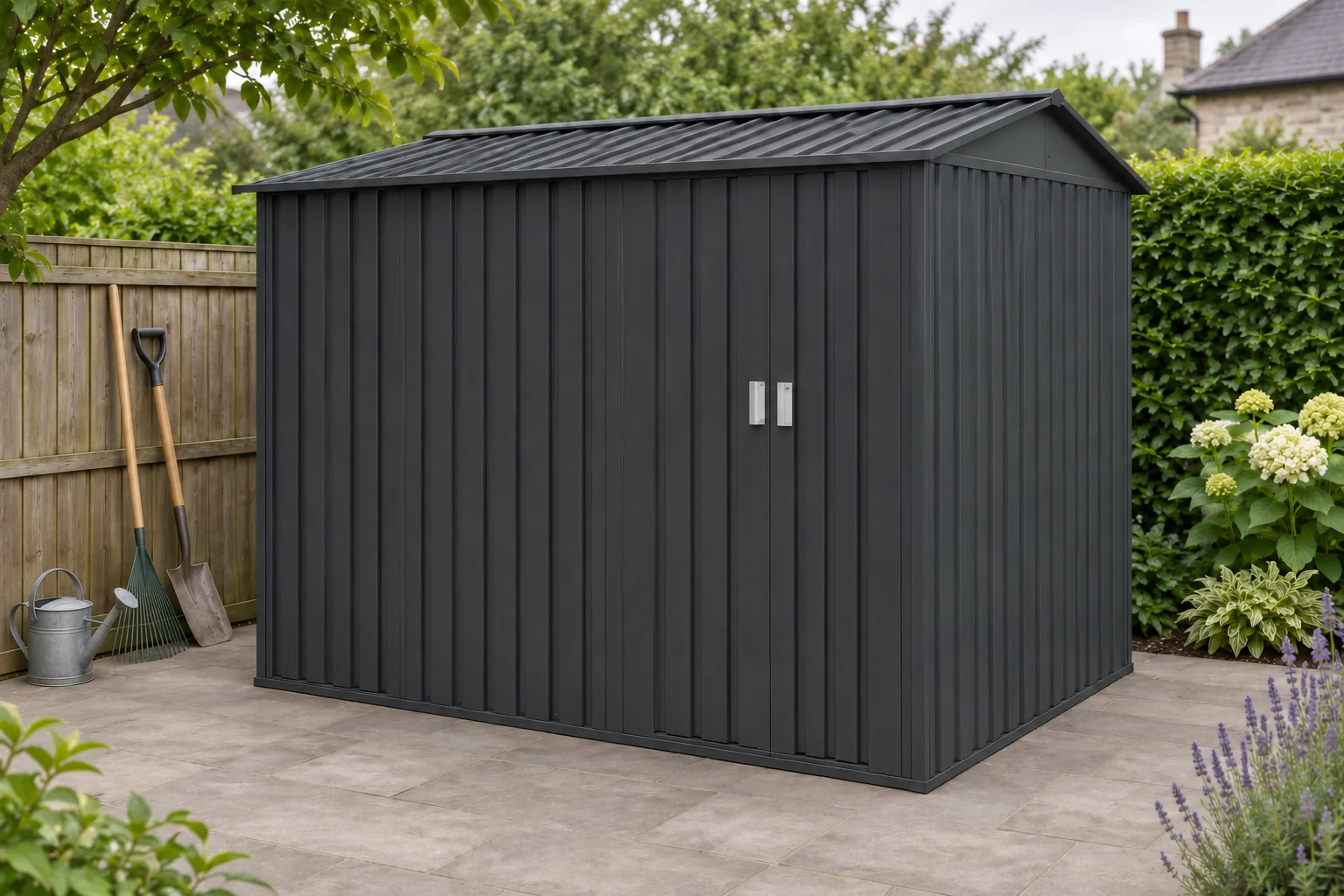
Start with the tool you use most often
Make a short inventory of what the shed will actually hold. Group equipment by how it is stored and removed, rather than by how many items you own. A narrow spade and a wide leaf rake may have similar handle lengths but need different positions.
| Equipment | Espaço para planear | Retrieval check |
|---|---|---|
| Rakes, forks and spades | Handle length, tool-head width and the position of hooks or holders | Can one tool lift free without catching its neighbour or the roof? |
| Hand tools and gloves | Shallow, visible shelf or organiser space | Can you find the item without moving a deep stack? |
| Watering cans and buckets | Body width plus projecting handles and spouts | Will the complete shape pass the shelf edge and entrance? |
| Mowers and wheeled equipment | Overall width, operating handles and a route to the doorway | Can the equipment leave without rearranging stored tools? |
Give the most frequently used tools the easiest positions. Seasonal items can occupy less convenient space, provided they do not block the daily routine. Planning a clear route now is more useful than filling every available corner.
Choose front-access storage or a shed you can enter
A small garden tool storage shed may be a tall, shallow store reached entirely from outside, or a deeper enclosure with room to step inside. Both can work well, but their layouts need different checks.
Front-access tool stores
Arrange the contents so each useful position is reachable from the opening. Keep an uninterrupted tall bay for long-handled tools and use shelves beside it for smaller equipment. A shelf running across the full width can prevent a long tool from standing upright even when the cabinet itself is tall enough.
Deeper sheds
Reserve space for approaching the stored equipment as well as space for the equipment itself. Wall storage can release floor space, but a projecting rake head or deep shelf can narrow that route. Sketch the proposed hooks and shelves on the same plan as the mower or other bulky item.
Try a simple retrieval exercise with your actual tools before ordering: stand the rake where you expect it to go, lift it as if removing it from a holder, and move it towards the proposed entrance. Notice where the head turns and where your hands need room. This helps identify awkward arrangements that a floor-area figure cannot show.
Use three separate measurements
Compare the outside dimensions, the usable interior and the clear entrance independently. The outside size helps position the shed. The interior tells you where equipment can sit. The entrance determines how it gets there.
For example, the LERYOU classic double-door metal shed has overall dimensions of approximately 181 × 246 × 195 cm. Multiplying its stated width and depth gives an outside nominal rectangle of about 4.45 m². This figure helps compare the space the enclosure occupies; use the interior layout and entrance measurements to plan storage and access.
The example combines corrugated steel wall and roof panels, an aluminium base, a reinforced frame and an apex roof with front double doors. Those details describe the enclosure. Shelves, hooks, racks and floor arrangements are separate configuration choices that shape how the storage works.
Mark the proposed footprint on the ground, then add the door movement, approach path and the access needed for care. For an apex roof, check both the ridge and the lower edges where equipment or shelving will sit. Overall height alone does not describe every storage position.
Match the door movement to the retrieval route
With hinged doors, leave the swing clear of fences, plant pots and parked equipment. Double doors may provide a useful way to reach more of the front, but compare the actual clear opening with the widest object you will move through it.
Sliding doors avoid an outward swing. Their useful opening depends on the panel arrangement and how far the doors travel. Check the fully open position, track and threshold rather than assuming the entire front becomes clear.
Think about the doorway as a working space. If you normally bring tools back in a barrow or carry several items together, leave a place to set them down beside the approach. Storage should not turn that approach into another parking area.
Plan shelves and hooks around the shed structure
Place long tools where their heads can remain separate. Shelves above or beside them should leave enough room to lift them from their holders. Keep smaller, frequently used items near a visible front edge instead of behind taller containers.
LERYOU’s garden shed range offers shelves, tool hooks and hanging racks as options for selected arrangements. Treat the choice of organiser and its attachment as part of the complete layout. A thin wall panel, a frame member and a purpose-made fixing rail are different interfaces; use fittings and attachment points specified for the shed.
Before adding equipment, compare the organiser’s stated load and mounting instructions with the intended contents. More hooks do not automatically create better storage. The useful question is whether the tools remain supported, separated and easy to remove.
Resolve the floor and moisture details before filling it
An outdoor garden tool storage shed needs a suitable supporting surface. Check the installation instructions for the required base, level, fixing arrangement and drainage. A base frame, a finished floor and the ground foundation perform different jobs, so compare the contents of the complete package.
Look at the threshold with wheeled equipment in mind. A mower that fits inside can still be awkward to put away if the approach is uneven or the entrance step is unsuitable for its wheels. Settle that access detail before placing shelves and tools around it.
Rain entry and condensation also need separate attention. Keep drainage and ventilation openings clear, remove soil and plant debris from tools, and let wet equipment dry before storage. Leave the planned airflow paths open when fitting organisers. A lockable door or a metal wall does not, by itself, resolve moisture inside the enclosure.
Compare materials through the care they need
Metal, timber and resin tool sheds can each suit garden storage. Compare the selected product’s construction and care instructions instead of relying on the material name alone. For coated metal, look after the finish and inspect damage; for timber, follow its treatment and roof-care requirements; for resin, follow the specified assembly, support and cleaning guidance.
Check the door hardware and lock arrangement separately. Enclosing tools keeps them out of view, while a lock controls access. Any claim about resistance to forced entry needs evidence for the particular product.
Questions to answer before choosing a tool shed
What size garden tool storage shed do I need?
Start with the longest and widest equipment, then add the space needed to reach and remove it. Compare usable dimensions and the clear entrance with that layout rather than choosing by an item count.
Can a small tool store hold long-handled tools?
Yes, when it has sufficient clear height and a suitable tall storage position. Check the space above the holder and beside each tool head, including any shelves crossing that position.
Is a walk-in shed always better than an upright store?
No. A shallow store can work well when everything is reachable from outside. A deeper shed is useful for a different mix of equipment, but needs room for circulation and retrieval.
Are shelves, hooks and a floor included?
Compare the package contents for the chosen configuration. In LERYOU’s classic shed range, organisers and floor solutions can be planned as options; select the arrangement together with the enclosure.
Should I choose hinged or sliding doors?
Choose by the available approach space and actual clear opening. Hinged doors need swing clearance; sliding doors need an unobstructed track and a panel arrangement that gives useful access.
Will a metal shed keep garden tools completely dry?
The roof, joints, base, ventilation and everyday storage routine all matter. Address rain exposure and internal moisture separately, and dry wet tools before putting them away.
What should I prepare for a configuration enquiry?
Gather your tool measurements, a sketch of the available position, the access route and your preferred shelf or hook layout. Include any wheeled equipment and the intended supporting surface.
To discuss a LERYOU shed configuration, send your tool list and proposed storage layout. The tool positions, opening and supporting surface give the discussion a practical starting point.
 English
 Deutsch
 Français
 Español
 Italiano
 Polski
 日本語
 한국어
 Nederlands
 Čeština
 Português do Brasil
 Русский
 ไทย
