
Flat-pack packaging is part of product development for garden sheds, greenhouses, storage products, patio structures and other outdoor systems. It affects component protection, warehouse handling, delivery, retail presentation, assembly and the customer’s first experience with the product.
A good package is not simply the smallest carton. It is a controlled system designed around the actual product, channel and logistics route.
1. Start With the Product Breakdown
Before designing cartons, map every component in the final product:
- wall, roof or glazing panels;
- long frame profiles;
- doors, vents and moving parts;
- bases, floors and accessory components;
- fasteners and hardware bags;
- instructions, labels and paperwork;
- fragile, coated or visible surfaces.
The product drawing, bill of materials, parts list and packaging list should use consistent identifiers.
2. Define the Distribution Channel
Retail, wholesale and e-commerce channels may create different handling conditions. A package for palletized store distribution is not automatically suitable for parcel networks or individual home delivery.
Clarify:
- warehouse and store handling method;
- pallet or unit movement;
- expected stacking and orientation;
- manual-lifting limits required by the buyer or market;
- parcel or bulky-item carrier restrictions;
- delivery to store, distribution center or consumer;
- display and label requirements.
Packaging choices should reflect the complete route.
3. Protect Panels and Visible Surfaces
Metal panels, coated profiles, polycarbonate sheets and glass components require different protection strategies.
Review:
- separation between finished surfaces;
- edge and corner protection;
- prevention of movement inside the carton;
- contact between panels, profiles and hardware;
- protective film and removal instructions;
- moisture and storage considerations relevant to the material;
- unpacking sequence.
Protection must be confirmed for the actual material and finish. Avoid copying one pack design across unrelated product families.
4. Control Long Profiles and Structural Parts
Long profiles can shift, bend or damage adjacent components if they are not restrained correctly. Their position in the pack should support both protection and efficient assembly.
Ask:
- Are similar profiles grouped and identified?
- Are exposed ends and finished surfaces protected?
- Can heavy components move onto fragile ones?
- Does the carton retain its intended orientation?
- Can the customer identify parts without unpacking everything?
Packaging engineers should review component weight distribution as well as carton dimensions.
5. Organize Hardware and Small Parts
Missing or confusing hardware creates support costs even when the main product arrives undamaged.
A controlled hardware system may use:
- sealed bags or compartments;
- part numbers matching the manual;
- separation by assembly stage where helpful;
- quantity checks during packing;
- protection from sharp edges;
- a documented replacement-parts process.
Avoid labels that depend only on color if the market or printing process may make them difficult to distinguish.
6. Design the Manual With the Package
The instruction manual should be available when the customer opens the package and should match the exact model and revision.
Confirm:
- model and configuration identification;
- required languages;
- parts list and hardware references;
- assembly sequence and orientation;
- safety and installation information;
- customer-service or replacement-part route;
- protection from damage inside the package.
When a product changes, the manual and package list must be updated together.
7. Plan Carton Artwork and Labels
For private-label programs, packaging may include brand, product name, model, handling information, barcode and destination-market information supplied or approved by the buyer.
Use an artwork approval process that records:
- dieline or print area;
- controlled product name and model;
- approved logos and colors;
- barcode source and verification responsibility;
- country or market information;
- handling marks supported by the actual package;
- revision and approval date.
Do not add performance, certification or environmental claims without appropriate evidence and approval.
8. Compare Retail and E-Commerce Needs
Retail packaging may prioritize pallet efficiency, store identification and consumer-facing artwork. E-commerce packaging may require additional attention to individual shipment handling, address-label areas and delivery damage.
Some products need different packaging versions by channel. Others can use one validated pack. Make that decision from handling evidence rather than assumption.
9. Validate the Final Package
The validation plan should match the product, package, route and buyer requirements. Depending on the project, review may include dimensional checks, packed-weight confirmation, handling trials, transit simulation or other agreed methods.
Any test result should identify:
- exact product and configuration;
- packaging materials and revision;
- test method and conditions;
- sample condition;
- acceptance criteria;
- changes made after the review.
A result for one carton should not automatically be generalized to a modified product or package.

10. Connect Packaging to Quality Control
Packaging quality begins before final packing. Panels, profiles, hardware and instructions must be correct before they enter the carton.
Useful controls include:
- approved packing specification;
- component and quantity checks;
- visual finish inspection;
- hardware-bag verification;
- manual and label version check;
- carton closure and strapping review;
- traceable records required for the project.
Change control is essential when artwork, components or package materials are revised.
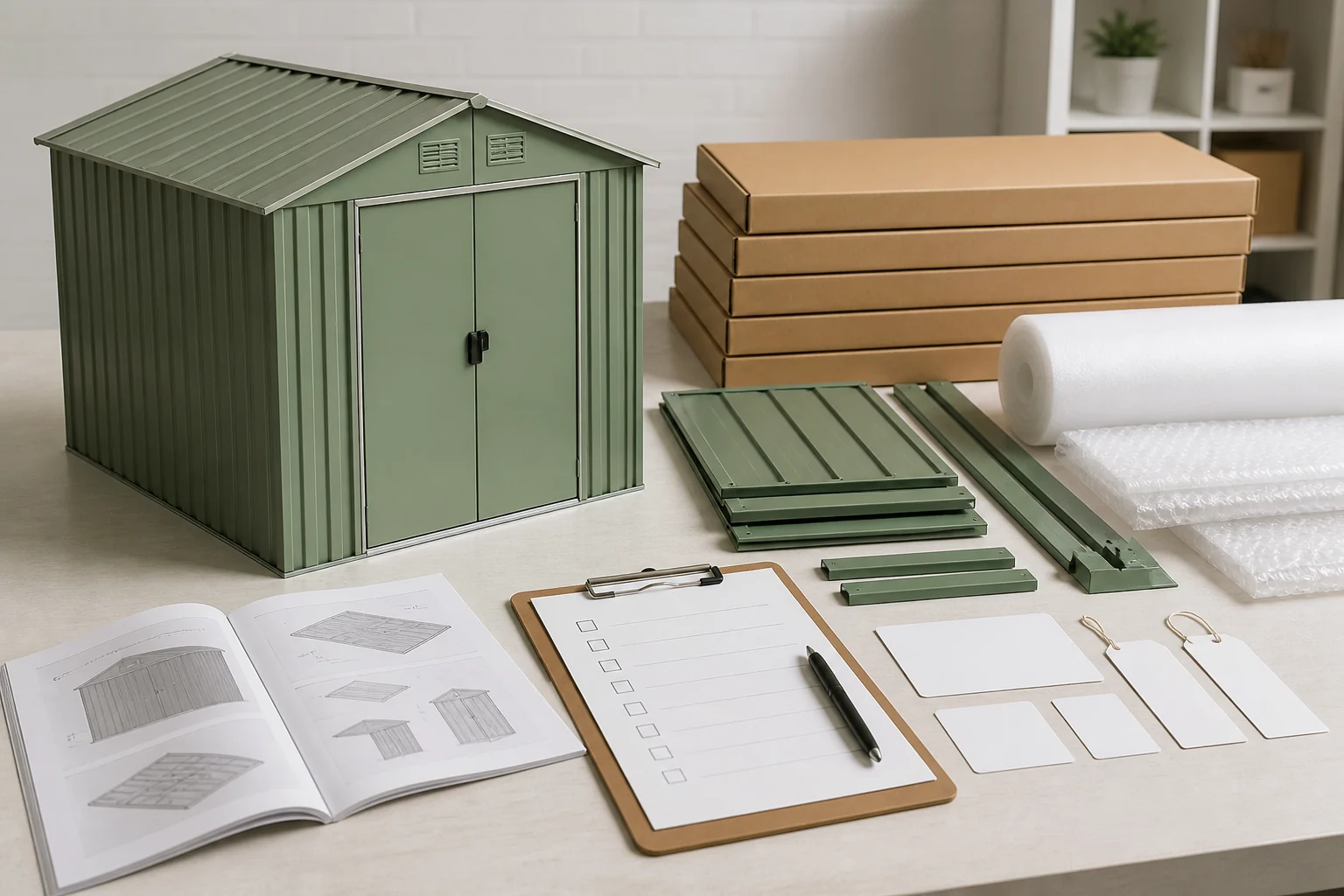
Flat-Pack Packaging Checklist
Before order approval, confirm:
- Is the pack based on the final bill of materials?
- Are panels, profiles, glazing and hardware protected appropriately?
- Is the package suitable for the actual channel?
- Do part labels match the manual?
- Are artwork, barcodes and languages approved?
- Does validation apply to the exact product and package revision?
- Are container quantities and shipment figures based on the final pack?
- Is there a process for packaging changes and replacement parts?
Frequently Asked Questions
Does flat-pack always mean one carton?
No. Large products may require multiple cartons. Package count should balance component protection, handling, assembly and logistics requirements.
Can retail packaging be used for e-commerce?
Sometimes, but it should be reviewed against the actual e-commerce handling route and carrier requirements before approval.
When should packaging development begin?
Packaging should be considered during product development and finalized with the approved specification, not added only after production planning.
What information should buyers supply?
Provide the sales channel, logistics route, labeling and artwork requirements, languages, barcodes, market information and validation expectations.
Develop the Product and Package Together
Explore LERYOU’s
garden and outdoor product range,
review
OEM, ODM, quality and shipment capabilities,
or
contact LERYOU
to discuss a flat-pack product program.
 English
 Deutsch
 Français
 Español
 Italiano
 Polski
 日本語
日本語 한국어
한국어 Nederlands
 Čeština
 Português do Brasil
 Русский