
Choose metal raised bed kits by their planting layout, panel construction and complete assembly system. A useful retail specification connects the growing space with the edges, joints, supports and components customers will handle. Compare the finished bed and its retail pack together before selecting a range.
Raised bed garden boxes can serve different spaces, from a narrow herb border to a larger vegetable plot. Start with where the bed will stand, how gardeners will reach the plants and whether the product sits directly on the ground or contains its own base.
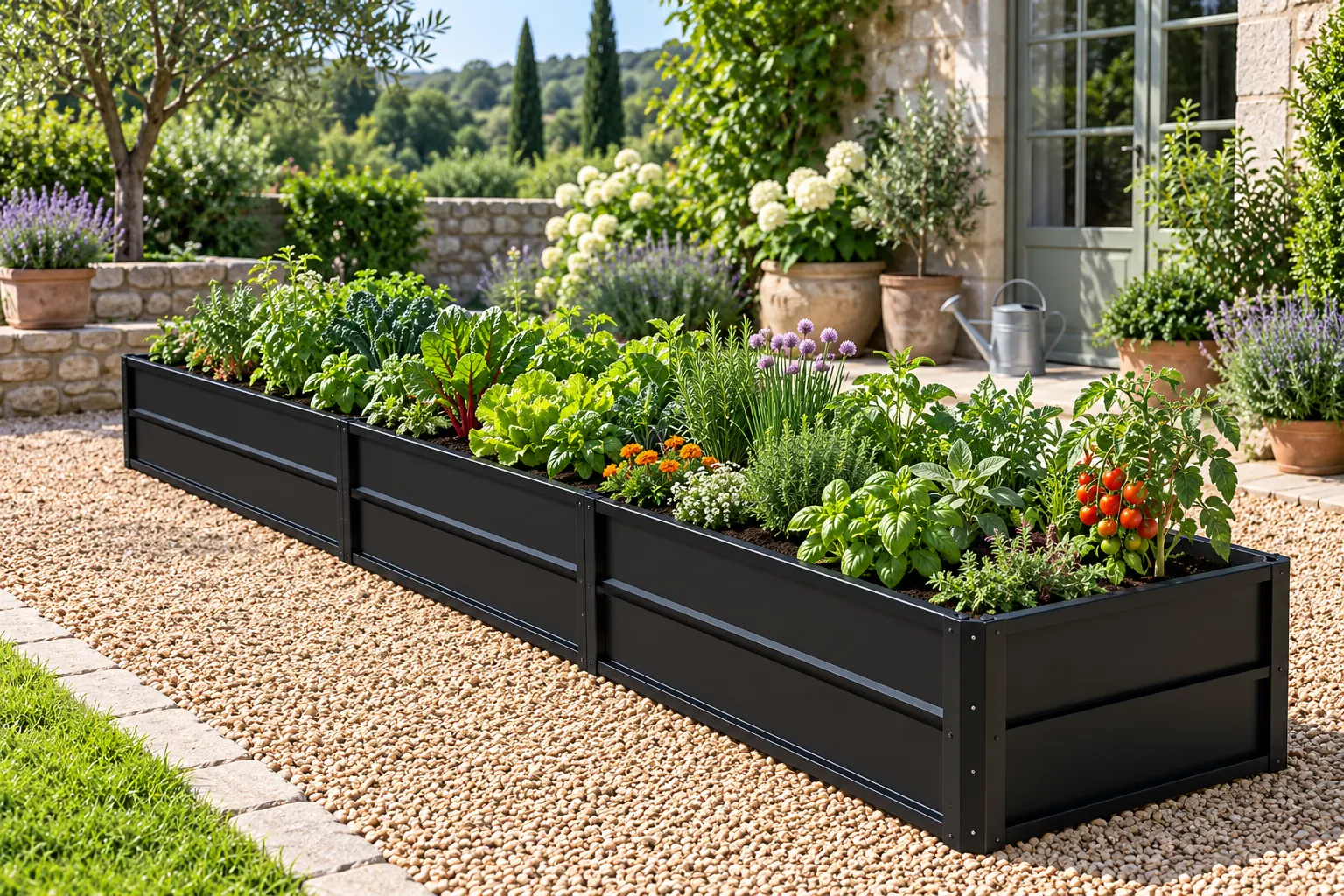
Define the bed format before comparing kits
A ground-supported raised bed forms a boundary around the growing area. A contained planter has a base, while an elevated planter also raises the container above the ground. Product names often overlap, so a search for a raised bed planter box can return several different constructions.
For a ground-level kit, establish how the lower panel edges meet the prepared site. For a contained planter, review its base, drainage arrangement and support requirements. For an elevated model, include the legs and the intended filled weight in the assessment. These differences affect installation, filling and the information customers need.
| Format | Selection priority | Retail information to provide |
|---|---|---|
| Ground-supported bed | Footprint, planting access and lower-edge arrangement. | Intended ground preparation, assembly sequence and filling instructions. |
| Contained planter box | Base construction, drainage and support surface. | Usable growing depth, drainage details and handling guidance. |
| Elevated planter | Container, legs, stability and working height. | Permitted loading and installation requirements for that model. |
LERYOU’s nursery and growing range includes modular raised beds and other planting formats. Keep each format’s dimensions, images and component list together when building a retail assortment.
Match the footprint to planting access
Measure the bed and the space around it. A bed against a wall is reached from one side; a freestanding bed can be approached from both sides. Test whether customers can tend the centre and corners without stepping into the planting area.
Allow space for watering, harvesting and passing between beds. A long narrow configuration can suit a border, while separate shorter boxes may make a layout easier to navigate. Compare these arrangements with a simple plan showing the surrounding paths and the customer’s working position.
Record external length and width separately from internal growing dimensions. Include corner sections, joining posts and any internal supports in the drawing. For modular beds, give each offered configuration its own assembled dimensions and parts list rather than assuming every panel combination is suitable.
Compare the complete metal construction
Panel profile and coating
Look closely at the supplied panel section. Flat panels, broad horizontal bands and fine corrugated profiles have different shapes and connections. Compare the actual profile, material specification and edge treatment together instead of selecting a product from a category label alone.
Record the base metal, sheet thickness and coating system as separate specifications. Check which surfaces are coated, how cut edges are finished and how panels are protected during assembly. A colour description does not identify the underlying coating system or establish a service life.
LERYOU’s modular steel raised-bed format uses colour-coated steel sheet and offers size and colour customisation. The system includes additional support bars and reinforcements. Select the required layout first so its panels, connections and supports can be specified as one complete kit.
Joints, supports and top edges
Inspect the corner connections, panel overlaps, joining posts and fasteners on an assembled sample. Check how the parts line up, how fasteners are accessed and whether the manual clearly shows their orientation. Review the position of supports before adding soil.
Soil pushes against the bed walls, making the assembled configuration important. A longer arrangement needs its own support layout. When comparing sizes, ask for the drawing and assembly instructions for each offered version, including the number and position of braces.
Check all edges customers will handle or reach across. Assess the top rim, corners, panel ends and exposed hardware. Where a kit includes edge trim, examine its attachment and whether it stays in position during normal handling. Include the same components in the sample and the retail pack.
Review placement, filling and everyday care
Choose the installation arrangement before filling the bed. A ground-supported frame needs a prepared position that allows it to sit as intended; a contained planter needs a suitable support surface and drainage route. Check how water will move through the growing area and around nearby paths.
Estimate fill from the internal planting area and intended fill depth. For a rectangular space, length multiplied by width multiplied by fill depth gives an initial volume estimate when all measurements use metres. Subtract space occupied by internal structures and keep the fill level within the product’s instructions.
Finish, growing medium, watering and local conditions belong in the care discussion. Assess claims about soil contact or edible growing against the specified material and coating. Review the proposed cleaning and maintenance guidance alongside the product sample, so the retail listing explains how the selected bed should be used.
Turn assembly and packaging into buying criteria
Assemble a sample using the supplied manual and hardware pack. Identify similar panels, count fasteners and check the order of fitting joints and supports. Note the tools and working space needed. This review makes it easier to improve instructions before a larger retail order.
Packaging should protect coated faces, corners and long panel edges. Keep metal parts from rubbing during transport and make the hardware pack easy to find. Check that the carton label, component list and assembly manual describe the same configuration.
For replacement parts, identify panels, joining posts, fasteners and supports consistently across the range. An extension kit should have a defined connection to its matching base kit. Show the resulting dimensions and all additional components needed for that approved arrangement.
| Buying record | Details to compare | Useful review |
|---|---|---|
| Layout | External size, internal growing space, access and configuration options. | Place an assembled sample in the intended garden layout. |
| Construction | Metal and coating specification, panel profile, joints and edge finish. | Inspect the full panel-and-connection assembly. |
| Support system | Bars, braces, joining posts and their positions for each size. | Follow the configuration-specific drawing and manual. |
| Retail pack | Carton size and weight, protection, hardware, labels and spare parts. | Unpack and assemble the retail-ready sample. |
Use the garden product supplier evaluation and RFQ checklist to organise the specification, sample review and quotation comparison. For adjacent covered-growing products, the cold frame buying guide covers lid access, panel construction and placement.
Frequently asked questions
What should a metal raised bed kit include?
The component list should identify the panels, joints, fasteners, supports and any edge protection required for the chosen configuration, together with assembly instructions. Check optional items separately so the retail pack is clear.
Is a raised bed planter box the same as an open-bottom bed?
The name alone does not establish the construction. Check whether the product has a base, how it drains and whether it sits on the ground or on legs. Match the listing to the actual format.
How do retailers choose a useful bed width?
Start with access. Test reach from the available sides, including the centre and corners, and leave enough surrounding space to work. Review internal growing width as well as the external footprint.
Does a taller or longer bed need the same supports?
Each configuration needs its own support arrangement. Compare the supplied bars, braces, posts and fasteners with the drawing for that exact size before approving an extended or taller version.
Are all metal beds suitable for edible crops?
Suitability depends on the specified material, coating and intended use. Request the relevant product documentation and care instructions for the selected model when evaluating an edible-growing range.
Can a bed be extended later?
A modular system can offer extension options when its connections and support layout are designed for them. Identify the compatible kit, additional parts and finished dimensions before offering an extension to customers.
How should metal raised bed kits be compared for a retail order?
Use a common specification covering layout, panel construction, coating, edges, supports, assembly and packaging. Compare complete configurations rather than panel prices, then review an assembled sample and its retail pack.
Build a clear raised-bed range brief
Start with the planting layout and intended customer, then define the panel system, support arrangement and retail pack. Review LERYOU’s manufacturing capabilities when planning a customised size, finish or product range.
 English
 Deutsch
 Français
 Español
 Italiano
 Polski
 日本語
 한국어
 Nederlands
 Čeština
 Português do Brasil
 Русский
 ไทย
