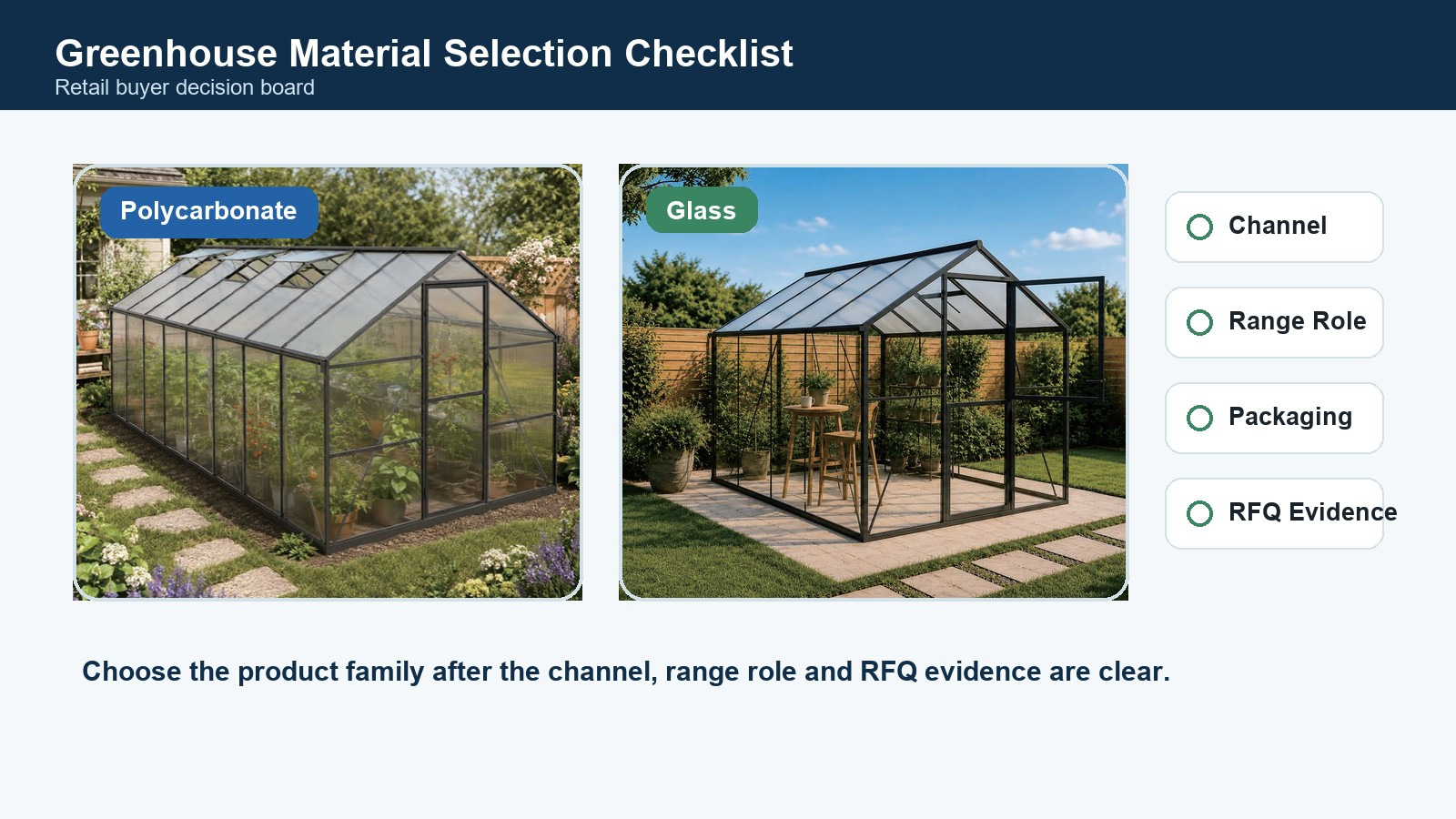
Контрольный список по выбору материалов для теплиц для покупателей розничной торговли
Most greenhouse material discussions start with the same question: should the buyer choose polycarbonate or glass? It is a fair question, but it is not usually the first decision a retail buyer or product manager has to make.
For a B2B greenhouse program, material choice sits inside a larger sourcing decision. The buyer has to define the sales channel, product role, size class, packaging route, documentation needs, after-sales expectations and quotation evidence before a supplier can respond usefully. A polycarbonate greenhouse, a glass greenhouse and a compact nursery-growing product can all be valid directions. The right choice depends on what the buyer is trying to sell and how the product will move through the channel.
This checklist is written for retail buyers, importers, distributors, garden-center teams and product managers who need to turn a broad material preference into a clear sourcing brief. It does not replace a technical specification, a structural review or a supplier quotation. Final materials, dimensions, performance requirements, packaging, commercial terms and market evidence must be confirmed for the selected greenhouse and destination market.
If your team still needs a direct material comparison, start with LERYOU's existing Polycarbonate vs Glass Greenhouse guide. If you are preparing a wider purchase brief, use the Greenhouse Buying Checklist for Importers alongside this article.
1. Start With the Buyer Role, Not the Material Name
Material decisions become easier when the buyer first defines the commercial role of the greenhouse. A product that works as a garden-center display item may not be the easiest e-commerce product to ship. A practical core greenhouse may not create enough visual difference for a premium retail range. A compact growing product may be a better seasonal add-on than a substitute for a walk-in greenhouse.
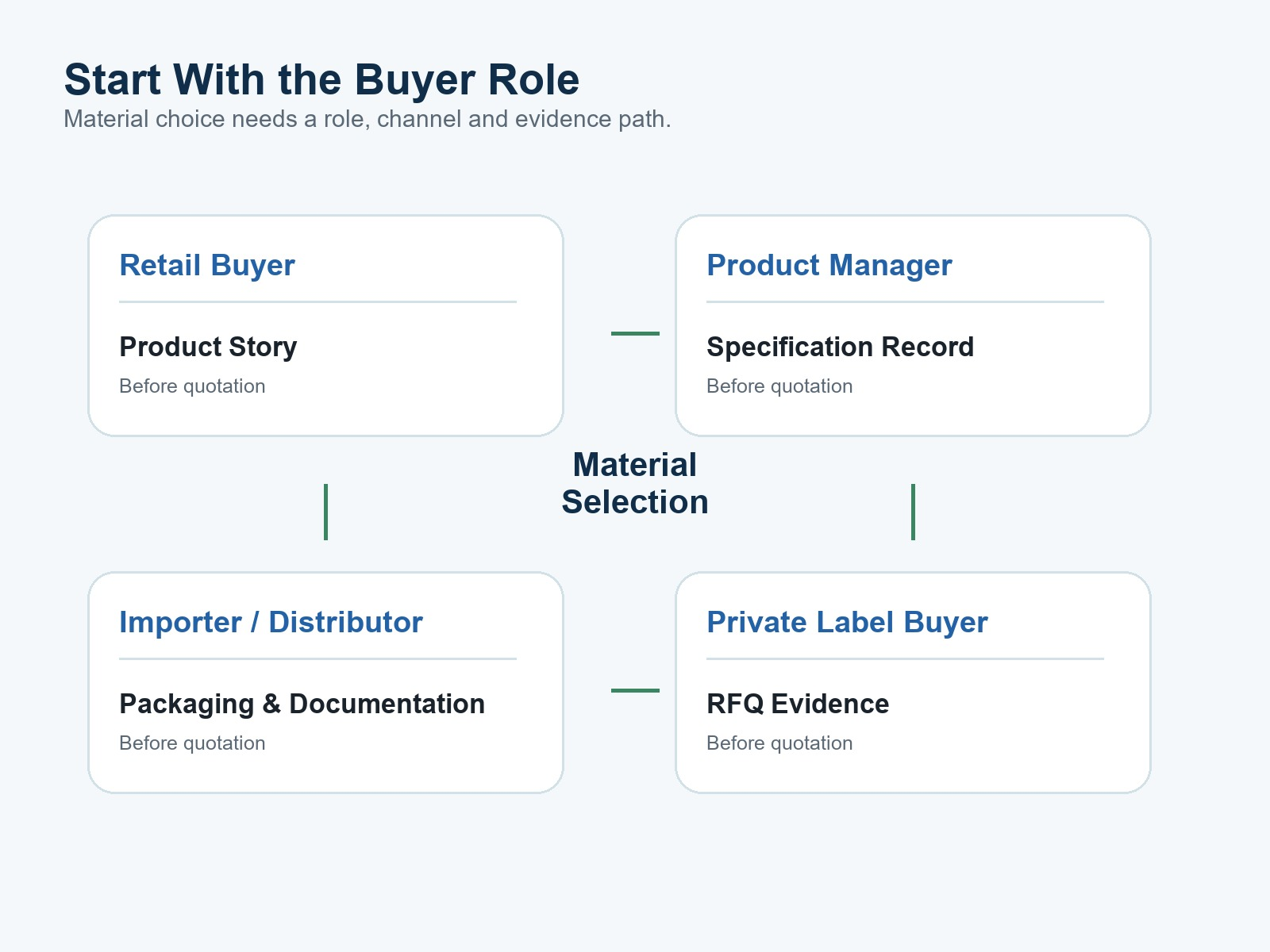
Before discussing material, record the buyer role:
- Retail buyer: needs a product story, shelf or display logic, package information and a clear reason for stocking the model.
- Product manager: needs controlled specifications, sample approval records, packaging files, manuals and product data.
- Importer or distributor: needs RFQ clarity, carton and shipping information, documentation expectations and market-level requirements.
- Private-label buyer: needs product scope, artwork ownership, label and manual approval, and consistent file control.
The same material can support different roles, but not automatically. A polycarbonate product chosen for a broad retail range, a glass product chosen for a visual upgrade position and a nursery-growing product chosen as a compact add-on should each have a separate business reason.
2. Define the Channel Before Choosing the Product Family
A greenhouse is not sold in a vacuum. Channel conditions affect material choice because they affect packaging, explanation, handling and after-sales support.
For each target channel, ask:
| Channel question | Why it matters before material selection |
|---|---|
| Where will the product be sold? | Garden centers, home-improvement retail, e-commerce and wholesale channels may need different packaging, imagery and product data. |
| How will the customer understand the difference? | If the buyer cannot explain why a material or model exists, the SKU may create confusion instead of conversion. |
| How will the product be handled? | Glass, polycarbonate panels, frames, hardware and cartons each have different protection and identification needs. |
| What documents are needed? | Manuals, labels, specifications, product data and artwork should match the approved product. |
| Which decisions must be confirmed before quotation? | Open material, size, door, vent, roof, carton and branding questions should be visible in the RFQ. |
This is where many buying projects become messy. Teams compare a material sample, a product photo and a price at the same time, without agreeing what the product is supposed to do. A cleaner process is to define the channel first, then choose the product family, then ask the supplier to confirm the model-level specification.
3. Separate Material Comparison From Product Line Selection
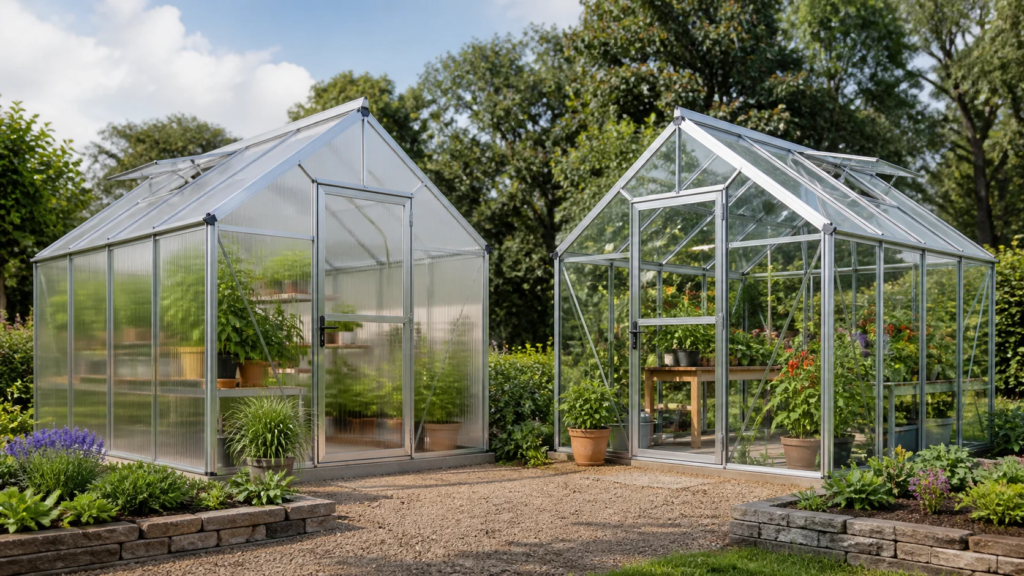
The existing material comparison question is still useful. Polycarbonate and glass can differ in appearance, handling, packaging, replacement considerations and retail positioning. But a retail sourcing decision should not stop at “polycarbonate versus glass.”
Use material comparison to answer one question:
Which material direction may fit this program?
Use product line selection to answer a different question:
Which greenhouse family, size direction, configuration and evidence package should we ask LERYOU to review?
That distinction prevents duplicate content and weak RFQs. A buyer may decide that polycarbonate is the main practical direction, but still need to choose between compact, mid-size, lean-to, T-shaped or upgraded configurations. Another buyer may prefer glass as a premium visual direction, but still need to confirm wall panels, roof options, doors, ventilation, shelving and packaging before a quotation becomes meaningful.
4. Use Three Product-Family Buckets
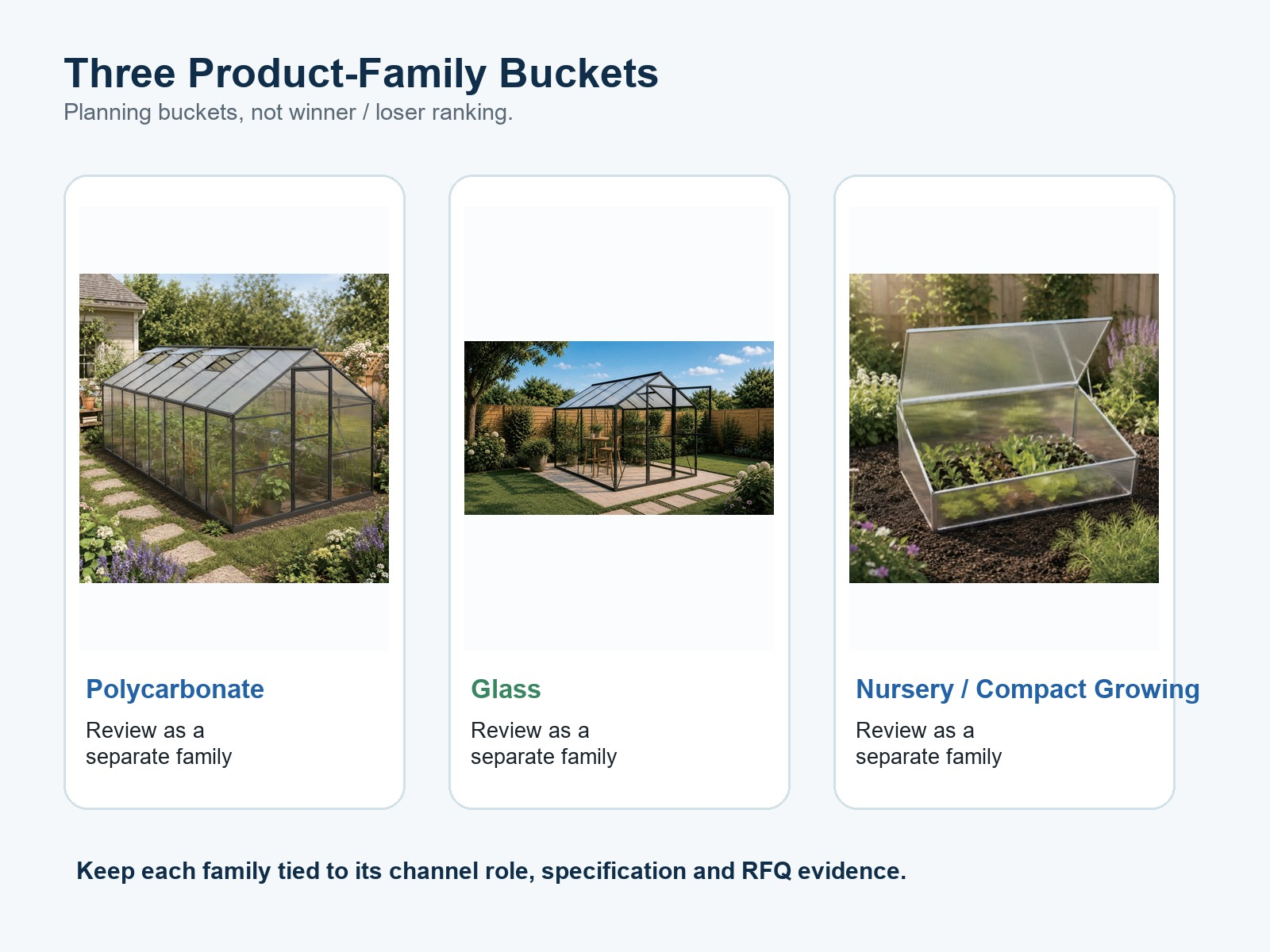
At the first sourcing stage, sort the program into product-family buckets. This is easier to manage than trying to compare every model at once.
Polycarbonate greenhouse direction
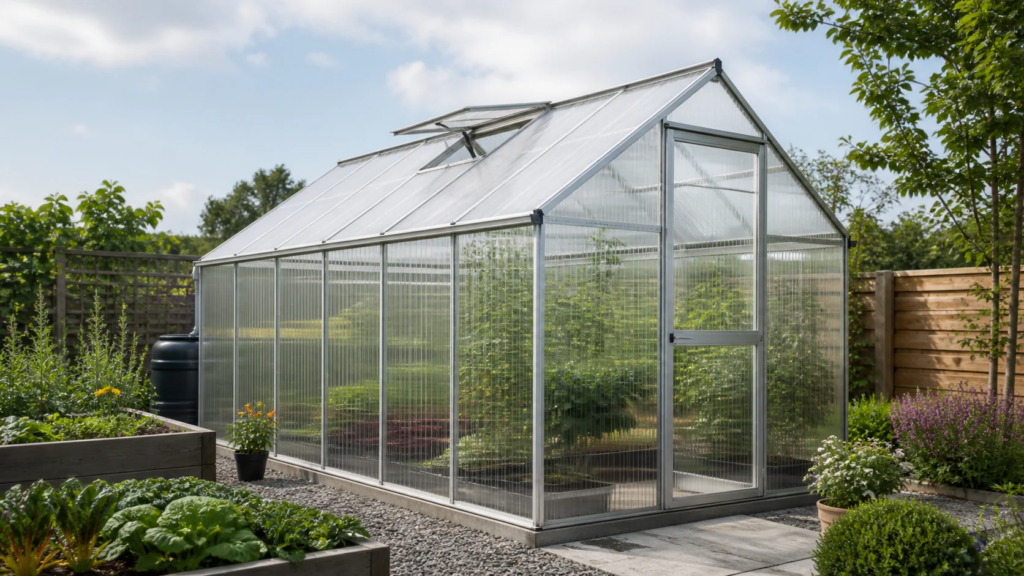
LERYOU's Polycarbonate Greenhouse range includes standard 6 ft, 8 ft and 10 ft formats, upgraded thicker-panel configurations, T-shaped layouts, dwarf-wall concepts and space-saving lean-to designs. Reference configurations use aluminium frames with 4 mm twin-wall polycarbonate or 1.8 mm solid PC panels, while selected upgraded configurations use 6 mm or 8 mm PC.
For retail buyers, the polycarbonate direction often works best when the product role is practical and range-driven: multiple size classes, manageable packaging, clear assembly explanation and a product story focused on everyday garden growing. The exact panel, frame, door, roof-window, gutter, colour and packaging choices still need model-level confirmation.
Glass greenhouse direction
LERYOU's Стеклянная оранжерея direction includes Prestige greenhouses, T-shaped configurations and dual-use greenhouse plus storage concepts. Selected Prestige configurations use aluminium frames with 4 mm tempered-glass walls. Glass or polycarbonate roof options, gutters, adjustable windows, door systems, colours and shelving vary by configuration.
For buyers, glass can support a more visual or premium garden-positioning story. The risk is assuming that “glass” already defines the product. It does not. The buyer still needs to confirm which areas use glass, whether the roof uses glass or another material, how panes are protected, and what the assembly and documentation requirements are.
Nursery and compact growing direction
Nursery and compact growing products can support a greenhouse range without trying to replace the greenhouse itself. Cold-frame, raised-bed or compact growing products may serve seasonal, entry-level or add-on roles for retailers that want a broader gardening offer.
Plan these products as a separate family. A compact growing product should not be compared with a walk-in greenhouse only by material. It should be compared by use case, packaging, merchandising, price position and customer task.
5. Match Material Direction to Retail Range Role
A useful range normally has roles rather than random models. For a retail buyer, each product should answer a question:
- Why should this SKU exist?
- Which customer does it serve?
- What makes it different from the next SKU?
- What does the sales team or product page need to explain?
- What evidence does the supplier need to confirm before launch?
Use this simple role map:
| Range role | Suitable material/product direction to review | What to confirm before RFQ |
|---|---|---|
| Core practical range | Polycarbonate greenhouse direction | Size class, panel direction, door type, vent layout, carton and manual requirements. |
| Premium visual option | Glass greenhouse direction or selected glass-wall configuration | Wall and roof material, pane protection, frame finish, access, shelving and packaging. |
| Space-saving solution | Lean-to or wall-attached greenhouse direction where available | Wall condition, installation dimensions, roof direction, drainage and market requirements. |
| Compact seasonal add-on | Nursery/growing products or cold-frame direction | Product task, package size, assembly steps, merchandising and replacement-part expectations. |
| Private-label program | Any confirmed family with approved artwork scope | Logo, carton artwork, labels, manual, barcode, approval ownership and file control. |
This table is not a ranking. It is a buying tool. A buyer may choose one family or combine several, but each item should have a clear range role.
6. Ask for Evidence in the Right Order
B2B buyers often ask for certificates, test data or performance claims before the product is even defined. That can slow the project down because the supplier does not know which configuration the evidence should apply to.
Use this order instead:
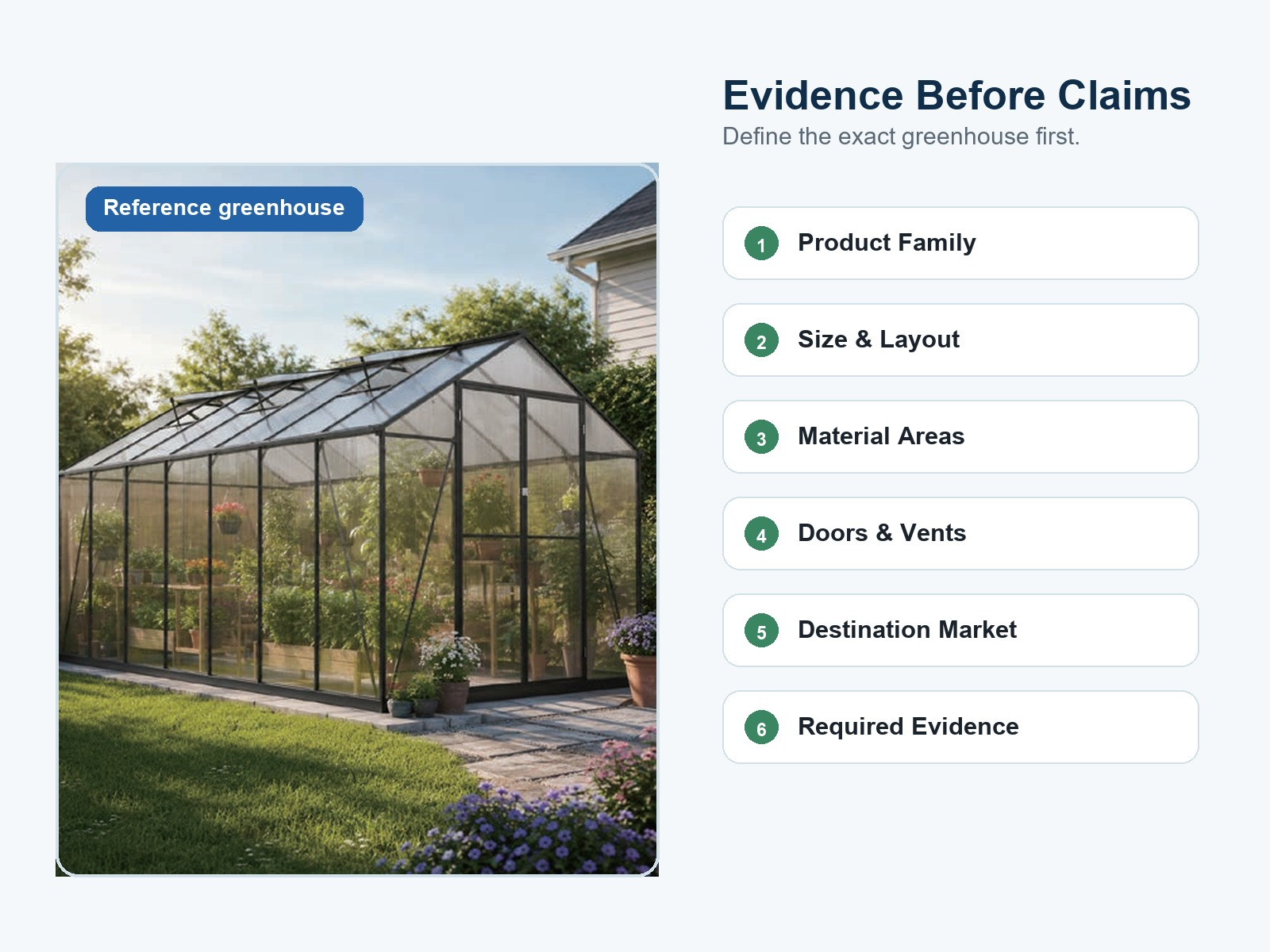
- Confirm the product family and reference model.
- Confirm the size direction and layout.
- Confirm the material areas: roof, wall, panels, panes and related parts.
- Confirm door, vent, gutter, base and accessory scope.
- Confirm destination market and channel.
- Identify any required structural, material, labeling, manual or packaging evidence.
- Ask whether the evidence exists for that exact model and configuration.
This wording matters. Do not ask, “Is this greenhouse certified?” as if every model shares one answer. Ask, “For this selected model, size and destination market, what documentation can be reviewed?” That is more precise and less likely to create unsupported marketing claims.
7. Build a Material Selection Scorecard
A scorecard helps a buyer compare real options without reducing the decision to price. The scorecard should be short, practical and linked to the channel.
| Область принятия решений | Buyer question | Supplier response needed |
|---|---|---|
| Product role | Is this core, premium, compact, add-on or specialist? | Recommended product family and reference models. |
| Material direction | Is the program leaning polycarbonate, glass or open comparison? | Material areas and model-specific options. |
| Size class | What footprint or retail size range is being considered? | Available reference formats and open compatibility checks. |
| Handling | Are there glass panes, PC panels, long profiles or fragile parts? | Packing logic, component protection and handling notes. |
| Сборка | Can customers identify parts and follow the sequence? | Manual scope, hardware grouping and part identification. |
| Market evidence | Are there required reports, labels or documents? | Evidence tied to the exact selected configuration. |
| Собственная торговая марка | Who owns artwork, barcode, labels and manual approval? | File-control workflow and approval checkpoints. |
| RFQ readiness | Is the brief specific enough for quotation? | Open questions and required buyer inputs. |
The scorecard also improves internal review. A product manager can show why a greenhouse was selected, what remains open and what the supplier must confirm before sample approval.
8. Keep Packaging and Documentation in the Same Decision
Material choice affects more than the visible greenhouse. It can affect how parts are protected, identified and explained to the end customer.
For polycarbonate products, the buyer should confirm panel protection, orientation, part labels and the relationship between panels and frame assembly. For glass products, the buyer should confirm pane protection, edge handling, package separation and safety notes where applicable. For compact growing products, the buyer should confirm whether the package and instructions match the simpler product role.
Packaging questions should include:
- package count and package dimensions for the selected model;
- component grouping;
- hardware bag and small-part identification;
- manual language and diagram requirements;
- carton artwork and label ownership;
- private-label file control;
- replacement-part or after-sales information required by the channel;
- whether packaging changes if the material or size changes.
LERYOU's Возможности page can be used as a process link for specification confirmation, customization review, approval and shipment preparation. Keep the language process-based. Do not turn process support into promises about fixed lead time, shipment volume or test results.
9. Avoid Five Common Material-Selection Mistakes
Mistake 1: Treating the material name as the specification
“Polycarbonate greenhouse” or “glass greenhouse” is not enough for quotation. The buyer still needs model, size, frame, panel or pane area, door, vent, packaging and documentation context.
Mistake 2: Comparing a premium image with a practical specification
Images help buyers understand the product direction, but they do not prove structural performance, carton design, manual quality or final market compliance.
Mistake 3: Moving price comparison ahead of scope
Two quotes are not comparable if one includes packaging, manual requirements and private-label artwork while the other leaves them open.
Mistake 4: Copying claims from one configuration to another
Panel thickness, glass type, roof option, door mechanism or performance evidence should not be copied across models unless confirmed for the selected configuration.
Mistake 5: Adding too many similar SKUs
If two products serve the same customer, channel and range role, the buyer may be adding complexity rather than choice. Use material direction to create meaningful range structure, not cosmetic variation.
10. Prepare the RFQ Brief
Once the buyer has selected a likely material direction, the RFQ should be specific enough for the supplier to respond. It does not need every detail finalized, but it should show what is decided and what remains open.
Include:
- target country or region;
- sales channel;
- buyer role and product range role;
- product family: polycarbonate, glass, nursery/growing or open comparison;
- preferred size class or footprint direction;
- reference product page, image or model if available;
- material areas that matter: roof, wall, panel, pane, frame and finish;
- door, vent, gutter, base and accessory preferences;
- packaging, manual, label and private-label requirements;
- quantity range if available;
- destination-market evidence or documentation requirements;
- open decisions where LERYOU should recommend options.
This turns the conversation from “Which material is better?” into “Which product direction can support this retail program, and what must be confirmed before quotation?”
Часто задаваемые вопросы
Is this article replacing the Polycarbonate vs Glass Greenhouse guide?
No. The existing Polycarbonate vs Glass Greenhouse guide covers direct material comparison. This article covers the next buying task: turning material direction into a retail sourcing brief.
Should a retail buyer choose polycarbonate or glass before contacting LERYOU?
Not always. If the range role, target market and channel are clear, the buyer can ask LERYOU to review both directions. The inquiry should state which decisions are confirmed and which remain open.
Can one greenhouse range include both polycarbonate and glass products?
Yes, if each product has a clear role. A range might include a practical core product and a more visual upgrade direction. Final models, materials, packaging and commercial terms still need confirmation.
Can product managers use this checklist for private-label projects?
Yes. Private-label buyers should add artwork, label, barcode, manual, packaging and approval ownership to the brief. A logo request alone does not define the full private-label scope.
Can performance be assumed from the material family?
No. Wind, snow, thermal, UV, structural or compliance claims must be tied to the exact model, material specification and destination market. Treat these as review requirements, not generic claims.
CTA: Send a Greenhouse Material Selection Brief
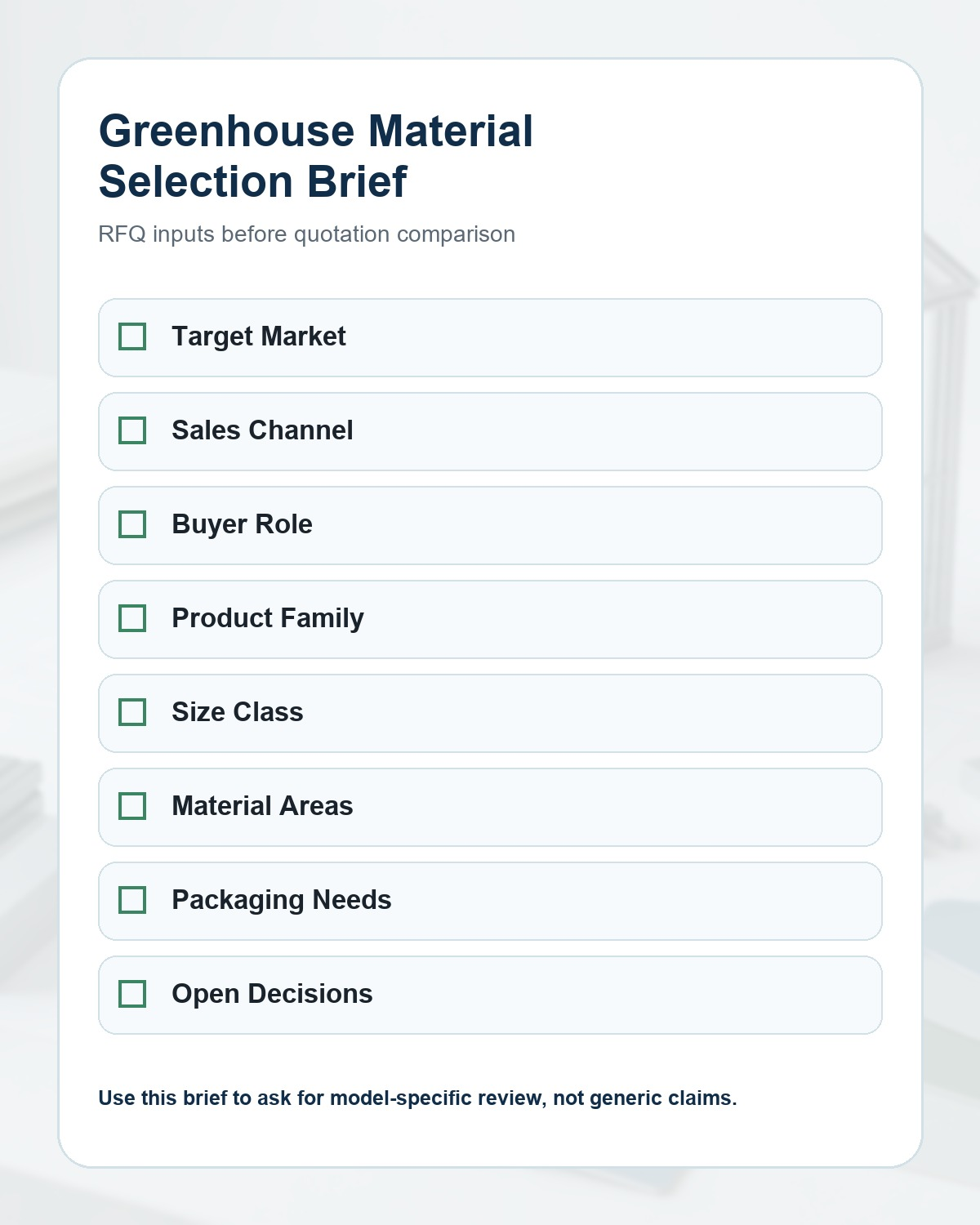
If your team is deciding between polycarbonate, glass or compact growing products, prepare a short material-selection brief before requesting a quotation. Start with your target market, sales channel, product role, preferred material direction, size class, packaging needs, documentation requirements and open decisions.
Review LERYOU's Решения для теплиц и выращивания растений, compare Polycarbonate Greenhouse and Стеклянная оранжерея directions, or связаться с LERYOU with your project brief. Final feasibility, specifications, evidence, commercial terms and timing should be confirmed for the selected program.
 English
 Deutsch
 Français
 Español
 Italiano
 Polski
 日本語
日本語 한국어
한국어 Nederlands
 Čeština
 Português do Brasil
 Русский