
Greenhouse shading is best evaluated as part of a complete growing environment. The percentage on a shade product describes a light-related characteristic; it does not specify a temperature reduction, a crop response or the performance of an installed greenhouse.
Research published in 2024 and 2025 gives retailers a useful way to look beyond that single number. The studies examine net colour, light transmission and the interaction between screens, glazing and ventilation. Their practical value lies in choosing better comparison criteria for a greenhouse range.
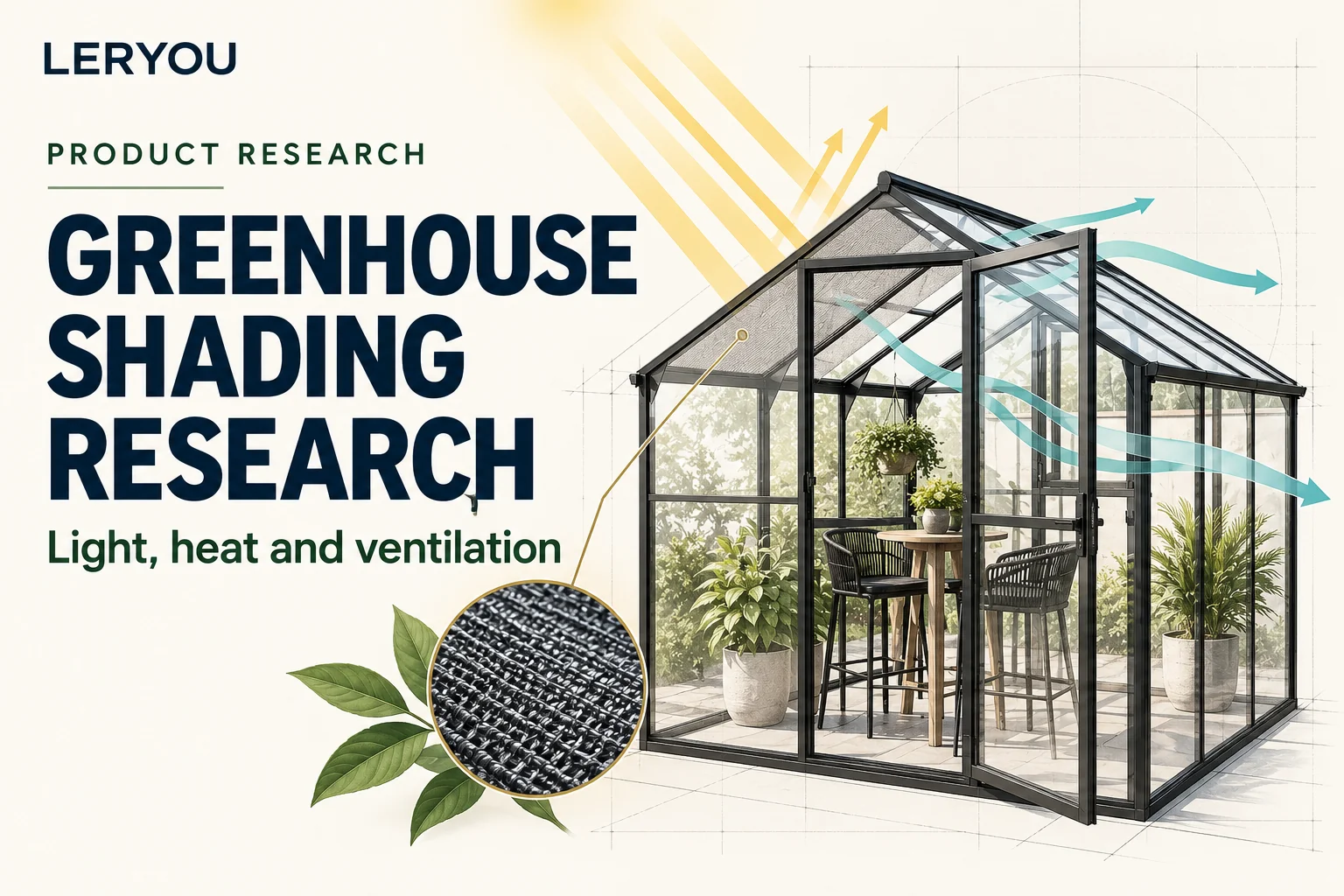
What the shade-net colour experiment examined
In a study published in Plants on 20 August 2024, Ibrahim M. Alhelal and colleagues at King Saud University compared green, black and beige nets, each rated at 50% shading, with unshaded blocks. The experiment used strawberries in a polycarbonate-covered greenhouse with fan-pad cooling in Riyadh. Cultivation ran from November 2022 to May 2023, with winter and spring observation periods.
The nets produced different light transmission and spectral conditions. Net colour had a comparatively modest effect on air temperature and humidity during the test. The original shade-net study therefore offers a reason to compare the light reaching plants, rather than treating equal nominal shade ratings as equivalent growing conditions.
The experiment concerned coloured nets inside an actively cooled greenhouse. Its findings do not establish a universal net colour or shade percentage for every crop, climate or small garden greenhouse.
Why shading and ventilation need a joint assessment
A second study, published in Frontiers in Energy Research on 24 March 2025, investigated shading and ventilation settings under different light-altering films. Sachin Gorakshnath Chavan and colleagues worked in six 105-square-metre compartments at Western Sydney University’s protected-cropping research facility.
The original shading and ventilation study compared winter tests in June 2021 with summer tests in January 2022. Energy outcomes depended on the covering treatment, operating settings and season. The facility used mechanical cooling, and each setting ran for only three or four days.
For buyers, this supports assessing the cover, screen and airflow arrangement together. The study’s energy-saving operating settings belong to that controlled facility; they are not instructions to close the vents of a naturally ventilated garden greenhouse in hot weather.
Translate the research into a useful product comparison
Start by defining the question a shading product is expected to answer. A gardener may need temporary protection for young plants, adjustable shade over one bench or seasonal shading across a larger roof. Those uses call for different coverage, adjustment and access arrangements.
Keep light management and heat management visible in the comparison. A cloth’s stated shade percentage is not a cooling percentage. Ask what was measured, how it was measured and whether the stated figure refers to the fabric itself or a complete installed system.
| Comparison point | Useful information | Reason to include it |
|---|---|---|
| Shade rating and optical data | Measurement method, fabric colour and transmitted light information. | Makes the meaning of the percentage clearer. |
| Greenhouse configuration | Glazing, footprint, vent positions and intended fixing points. | Connects a shading product to the actual structure. |
| Operating arrangement | Internal or external position, coverage, adjustment and removal. | Shows how customers will use the shading through the season. |
| Evaluation conditions | Weather, crop, watering, ventilation and measurement positions. | Makes temperature or growing comparisons easier to interpret. |
Internal and external shading have different installation needs
External shading intercepts sunlight before it passes through the glazing. Internal shading is fitted beneath the cover and must be considered alongside the air space around it. In either position, assess the complete movement of roof vents, doors and any adjustable screen.
For greenhouse glass shading, inspect the pane dimensions and the proposed attachment system. For a frame-mounted cloth, check the connection to the actual profile. A fixing intended for one greenhouse does not establish compatibility with another structure.
Shade cloth for small greenhouse layouts should also be manageable at the scale of the product. Review where customers will reach the controls, how the cloth is taken down and where it is stored. A sample fitting review should include opening the vents and doors through their normal travel.
Make a seasonal comparison, not a permanent setting
Strong sunshine and dull weather create different light conditions. Adjustment and removal are therefore useful product features to assess alongside the material. Explain clearly which area is shaded and how customers can change the arrangement as growing needs change.
When evaluating a sample, record the date, weather and operating conditions. Place temperature measurements where they answer the growing question, and record watering and ventilation consistently. A shaded thermometer reading and an exposed reading are different measurement conditions, even if both appear on the same product sheet.
What this means for a LERYOU greenhouse range
LERYOU’s glass greenhouse range includes aluminium-frame configurations. Product selection should bring together the glazing arrangement, openings, intended planting use and accessory fit.
Use the greenhouse material selection checklist to organise the cover specification. The greenhouse ventilation buying guide provides the companion review of opening layout and operation.
A clear retail proposal describes the selected structure and the proposed shading arrangement separately, then shows how they work together. That gives customers useful information about coverage, fitting and daily adjustment without relying on a general cooling promise.
Frequently asked questions
Does 50% shading mean a 50% lower temperature?
No. A shade percentage is a light-related rating. Temperature depends on the installed greenhouse and its operating conditions, so a cooling claim needs its own measurement evidence.
Is one net colour always the best choice?
No single colour follows from the studies as a universal choice. Compare the stated optical properties and intended crop conditions alongside practical fitting and adjustment.
Can shading replace ventilation?
They perform different jobs. Shading limits incoming light, while ventilation exchanges air. Review both arrangements and keep openings usable when the screen is fitted.
Should greenhouse glass shading be inside or outside?
Compare the interception of sunlight with the fitting, exposure and adjustment requirements. Check the glazing, frame connections and full vent movement for the proposed position.
What matters when choosing shade cloth for a small greenhouse?
Coverage, compatible fixings, access to controls and removal are practical starting points. Check the intended growing use and light requirements as well as the nominal shade rating.
What evidence should support a temperature or yield claim?
Look for the original test, its crop and climate, greenhouse construction, cooling and ventilation settings, and measurement method. Keep the result tied to those conditions.
Build the next product brief around measurable requirements
The useful research message is to compare a complete system: cover, screen, openings and operating conditions. For retailers, a well-defined fit and adjustment brief is a stronger starting point than selecting the darkest cloth or the largest percentage.
Organise samples and documentation with the garden product supplier evaluation checklist.


 English
 Deutsch
 Français
 Español
 Italiano
 Polski
 日本語
 한국어
 Nederlands
 Čeština
 Português do Brasil
 Русский
 ไทย
