
An outdoor potting bench with cabinet combines a planting work surface with enclosed storage for garden tools and accessories. Choose the layout around the gardening tasks you do most often: filling pots, handling seed trays and putting equipment away. Compare usable worktop space, cupboard access, materials and assembly to find a bench that fits your garden and routine.
Before you buy, measure your available space and list the items you want to keep at the bench. A dimension drawing, photographs of the open storage compartments and a clear parts list help you compare how different designs will work in practice.
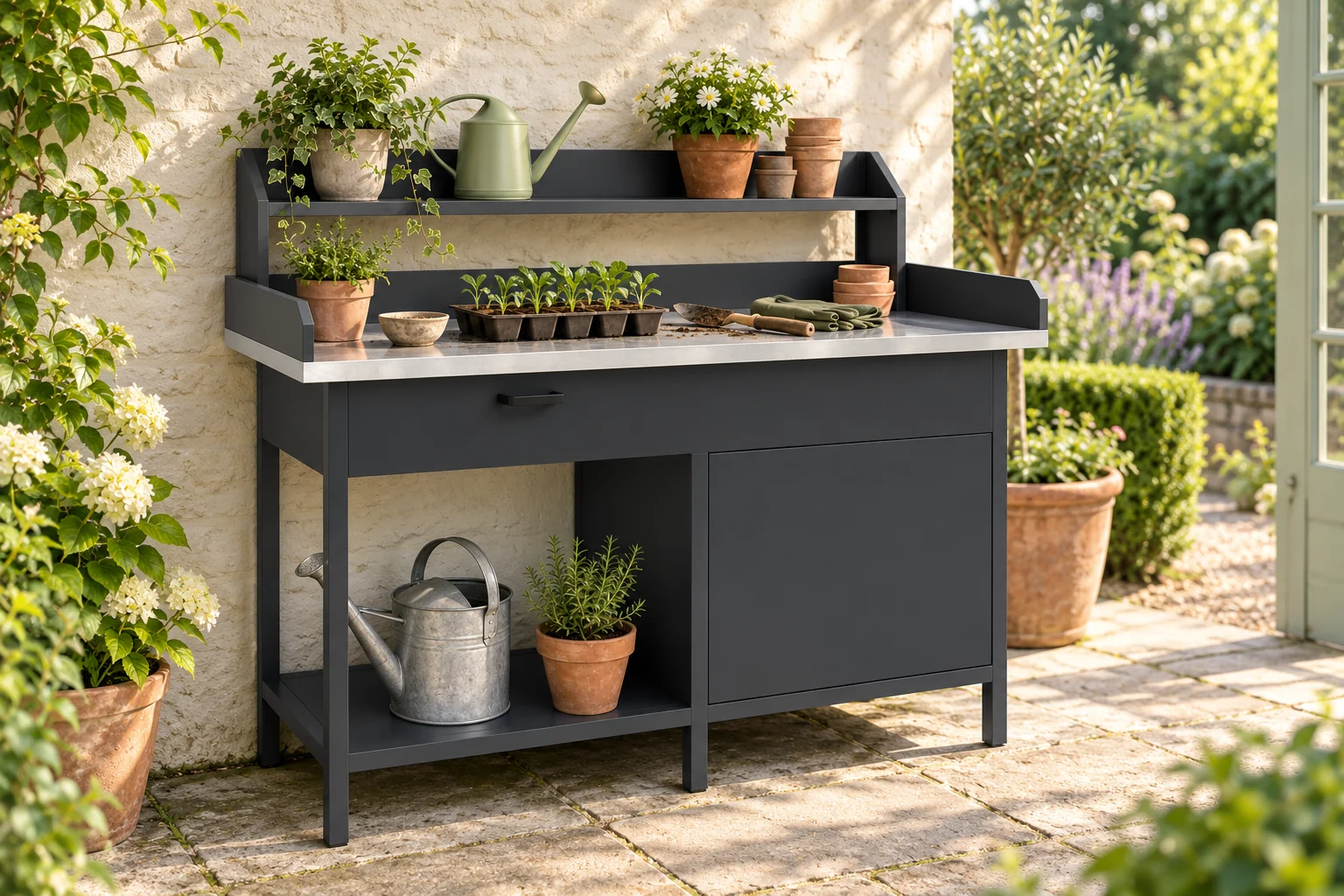
Match the storage layout to everyday gardening
Start with the items you need beside the worktop. Small hand tools suit a drawer; stacked pots and watering cans can sit on an open lower shelf; a cupboard keeps selected accessories out of view. A narrow upper shelf provides another place for small pots while leaving the main surface available for planting.
An outdoor potting bench with cabinet storage is especially useful where the workstation also forms part of a patio or garden display. Enclosed storage can make the area look tidier, but it needs enough clear space in front for the door to open. Check access with the bench placed against a wall and with a person standing at the worktop.
| Storage feature | What to compare | What to check |
|---|---|---|
| Cupboard | Internal space, door opening and shelf arrangement | Check the internal dimensions and whether your containers fit through the door |
| Drawer | Usable depth, handle position and movement | Check that the drawer opens comfortably while you stand at the worktop |
| Open lower shelf | Clear height and available floor area | Allow room for pots or a watering can without blocking the cupboard |
| Upper shelf | Depth and clearance above the worktop | Check that the shelf leaves enough height for the plants you handle |
Measure the working surface separately from the overall size
Overall width and depth describe the space the bench occupies. They do not always describe the usable worktop: raised edges, uprights and a rear shelf can change the working area. Request both sets of measurements, together with the height from the floor to the planting surface.
Compare dimensions using a typical pot, seed tray and compost container. Use their measurements to check whether there is room to fill and turn a pot without moving everything else. If you can try the bench in person, test this arrangement at the worktop. For an upper-shelf design, check the clearance for taller plants and whether the shelf obstructs access to the rear of the worktop.
Measure the route into the intended garden or greenhouse as well. Door openings, paths and the space needed for assembly can matter as much as the final footprint. A compact listing image can hide a large difference between total height and worktop height.
Compare the frame, worktop and cabinet materials
A metal worktop does not describe the whole bench. The frame, cupboard panels, shelves, hinges and fasteners may use different materials and finishes. Read the material description for each component, especially when the product title highlights only the worktop.
Frame and finish
For a powder-coated metal structure, inspect the finish around corners, joints and fastener holes. Look for consistent coverage and check that assembly does not require forcing coated parts together. Follow the supplied care instructions when cleaning and maintaining the finish.
Worktop and storage compartments
Check the worktop material, edge construction and fixing points separately. Confirm how loose compost can be removed and whether the surface has joints where debris collects. Inside the cupboard, inspect exposed edges, shelf supports and the clearance between the door and frame.
Check the stated capacity of each surface or compartment before loading it. A worktop capacity should not be applied to a narrow upper shelf or drawer. Where a load figure is part of the buying decision, obtain the applicable specification for the exact configuration.
Choose a practical outdoor position
A level, stable surface gives the bench a sensible starting point for assembly and use. Plan enough space for the gardener, open cupboard door and extended drawer. Keep the workstation clear of a frequently used doorway, and consider where water will go when nearby pots are watered.
A sheltered position can reduce direct exposure to rain and keep the work area easier to use between showers. Select the location alongside the product’s placement and care instructions. The word outdoor alone does not establish that a storage compartment is sealed against rain.
Put tools away clean and dry, and keep loose soil from collecting around hinges and drawer runners. Treat potting storage as part of the gardening workspace; products that require secure or moisture-controlled storage need their own suitable storage arrangement.
Check assembly, access and what is included
Before ordering, check whether the bench arrives assembled or flat-packed, which tools are needed and whether the instructions are available to read. Confirm the delivery dimensions if the carton needs to pass through a narrow hallway or garden gate.
When the bench arrives, compare the parts and hardware with the supplied list before starting assembly. Follow the stated sequence on a level surface, then check that the frame is stable and that the cupboard door and drawer move freely. Inspect the worktop and panels for transport damage before using them.
Look carefully at what the purchase includes. Pots, watering cans and tools used to style a product photograph may be separate accessories. If a replacement handle or hinge is needed later, a clear model reference and parts diagram can make it easier to identify the right component.
Fit the potting bench into your growing space
A potting bench provides a place to work; a cold frame provides a protected growing enclosure; a raised bed provides a planting area. Choose according to the task you want to solve. The cold frame buying guide and raised bed buying guide explain those different growing options.
LERYOU’s CWG-17 garden potting bench combines a powder-coated metal structure with a worktop, upper and bottom shelves, a drawer and a cabinet. You can explore the LERYOU nursery and growing products to see the potting bench alongside other growing equipment.
Frequently asked questions
What is the difference between a potting bench and a potting bench with cupboard?
A basic potting bench provides a work surface and may have open shelves. A potting bench with cupboard adds enclosed storage, making the door opening and internal layout additional points to compare. Both designs need enough clear working space for planting tasks.
Does a cabinet make an outdoor potting bench waterproof?
No. A door encloses the storage area, but weather protection depends on the compartment’s construction. Choose the placement and stored items according to the exact product specification and care instructions.
What size potting bench will fit my space?
Measure the available width and depth, then compare the overall size, usable worktop and working height. Leave space to stand, open the cupboard door and extend the drawer. Also check the cupboard opening and shelf clearances against the items you want to store.
Is a metal worktop the same as an all-metal bench?
No. Worktop, frame and cabinet materials can differ. Compare the material and finish of each major component rather than using the worktop description for the complete product.
Does a potting bench need a sink?
A sink is optional for the category. A flat worktop can support pot filling, repotting and seed-tray preparation. If a sink is required, compare the bowl, drainage and any water connection as separate features of that model.
What should I check after assembling the bench?
Check that the parts and hardware match the instructions, the frame is stable, panels align and the drawer and cupboard door open freely. Follow the assembly instructions before placing tools or pots on the bench.
Is a cupboard or an open shelf better for gardening tools?
A cupboard keeps tools out of view, while an open shelf gives quick access to pots and watering cans. A mixed layout can provide both. Compare the actual compartment dimensions and keep tools clean and dry before putting them away.
Choose a bench that suits the way you garden
Start with your available space, the pots you handle and the tools you want nearby. Then compare the worktop, cupboard, shelves and care requirements. The right layout gives you room to plant while keeping the essentials within reach.
 English
 Deutsch
 Français
 Español
 Italiano
 Polski
 日本語
 한국어
 Nederlands
 Čeština
 Português do Brasil
 Русский
 ไทย
