Para compradores de abrigos de jardim, retalhistas, importadores e gestores de sortido
Which garden shed material is more durable, and which costs less to sell and support? Metal, resin (plastic) and wood can all be viable, but no material label answers those questions by itself. The structure, finish, installation conditions, package, maintenance instructions and evidence for the exact model matter more than a generic ranking.
Short answer: compare the complete quoted shed and its landed and after-sales costs. Metal can support a broad range of roof, door and finish directions; resin can provide moulded components that do not rust but still need UV, temperature and joint checks; wood can offer a natural appearance and repairable components. Each benefit depends on the selected product and how it is made, installed and maintained.
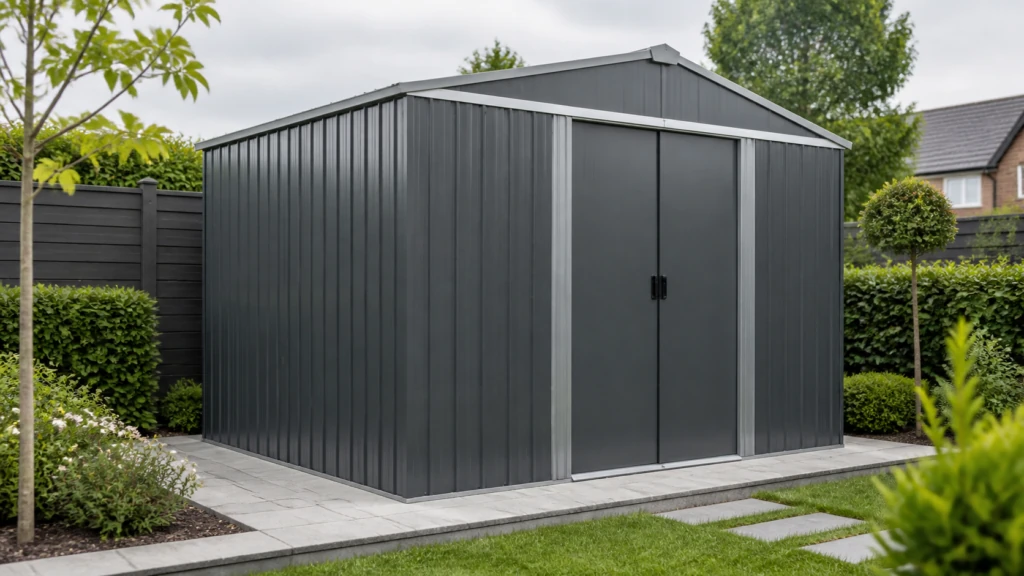
LERYOU’s current garden-shed supply is metal-led. Resin and wood are discussed as competing material directions for buyer evaluation—not as LERYOU product lines.
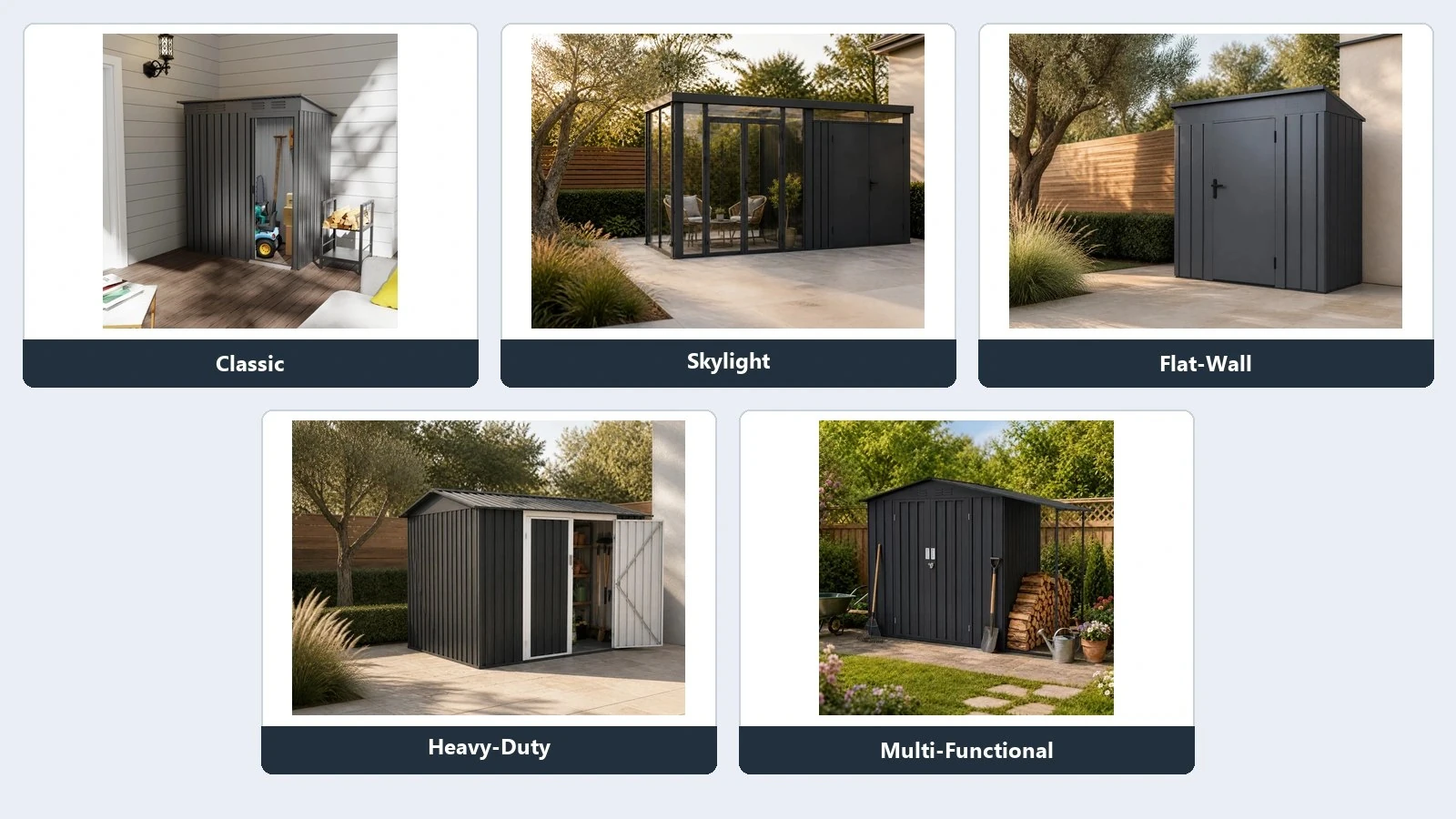
Metal vs resin vs wood: what is the practical difference?
For a retailer, the best material is the one whose exact model meets the intended storage job, target price, site conditions and customer-support capacity. Ask for model-specific evidence before calling one shed “stronger,” “cheaper,” “maintenance-free” or “faster to assemble.” Resin is a type of plastic; formulations and reinforcements differ, so a resin claim should not be assumed for every plastic shed.
| Pergunta do comprador | Abrigo em metal | Resin / plastic shed | Abrigo em madeira |
|---|---|---|---|
| What controls durability? | Steel, coating, connections, roof and wall geometry, base and installation | Resin formulation, wall structure, reinforcement, joints, UV exposure and temperature range | Timber species and grade, treatment, moisture detailing, roof, fixings and upkeep |
| What cost belongs in the comparison? | Panels and frame, finish, hardware, carton protection, assembly and replacement parts | Moulded parts and tooling, reinforcement, carton volume, assembly and replacement panels | Timber and treatment, package weight, installation, periodic finishing and replacement parts |
| What should the buyer inspect? | Coating/finish evidence, panel edges, fasteners, ventilation and base | UV and temperature claims for the exact formulation, joints, supports and base | Moisture protection, treatment instructions, joint details and maintenance schedule |
| What may affect assembly? | Panel identification, frame alignment, fastener count and anchoring | Part size, joint fit, reinforcement and base preparation | Panel squareness, fixing sequence, roofing and site preparation |
| What should the retail listing show? | Exact included structure, dimensions, door opening, finish and required base | Exact panel and support system, dimensions, access and required base | Exact timber and finish scope, dimensions, access and upkeep instructions |
Do not use this matrix as a lifespan or price ranking. Compare quotations and test records for equivalent size, use and destination market; ask suppliers to identify the SKU and configuration behind every claim.
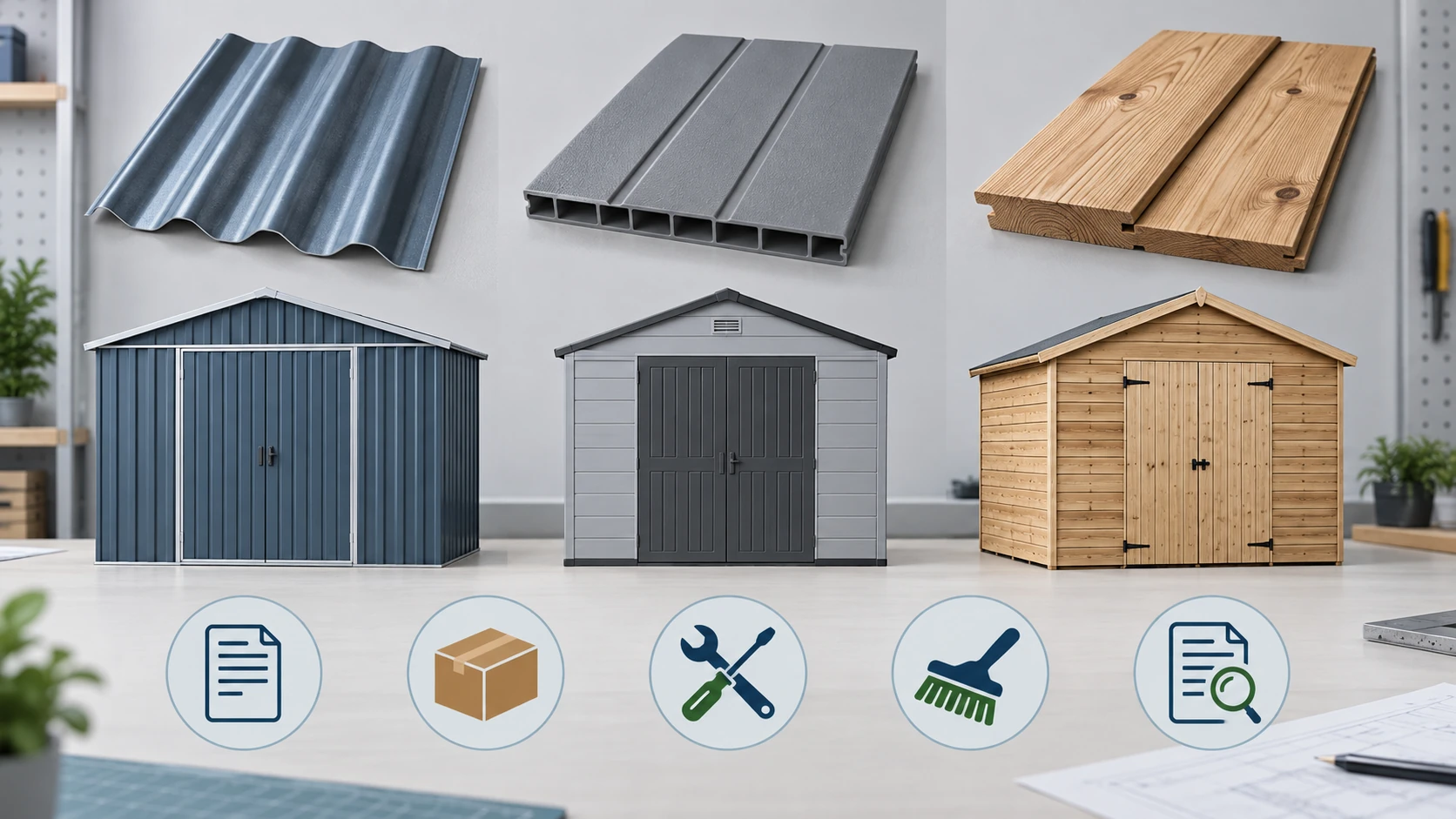
How to compare durability without inventing a lifespan
Durability is a property of the complete shed in its intended setting, not simply of “metal,” “resin” or “wood.” A retail team should ask what can fail or require maintenance on the selected model: roof and wall joints, surface finish, panel supports, door hardware, foundation interface and fasteners. Evaluate those points against expected weather, location, use and care instructions.
- Metal: confirm the steel and finish specification, exposed edges, drainage and any product-specific corrosion or structural evidence. A coating claim does not describe every joint or cut edge.
- Resin/plastic: confirm the actual polymer system, reinforcement, joint design and evidence for claimed UV or temperature performance. “Plastic” is not one formulation.
- Wood: confirm timber species/grade, treatment, moisture detailing and the maintenance the retailer will need to explain to customers.
Do not publish a universal service-life figure for a material category. If a supplier provides a warranty or test report, identify the covered model, conditions and exclusions before quoting it.
Compare total cost, not just the unit quote
A fair B2B comparison uses the same target footprint, access requirement, destination and quantity. Then calculate landed unit cost + handling and assembly support + expected maintenance and replacement support. These inputs can change the range decision even when one supplier has the lowest ex-factory price.
- Purchase and freight: compare the quoted configuration, number of cartons, packed dimensions, weights and loading assumptions.
- Retail handling: consider damage risk, missing-part processes, manual clarity and time needed for customer support.
- Ownership and after-sales: identify finish care, replacement hardware/panels and the scope of any warranty.
Ask each supplier to separate included items from optional bases, floors, vents, locks and accessories. Do not present a generic metal/resin/wood price tier as a product quote.
Traduza a escolha do material num papel de retalho
Uma gama deve dar a cada material uma razão distinta de existir. A equipa de compras pode definir posições de entrada, núcleo e premium, mas os rótulos devem seguir as diferenças reais do produto. Evite usar o material isoladamente como indicador de qualidade.
- Papel de entrada: área controlada, caso de uso claro, configuração limitada e história de embalagem simples.
- Papel de núcleo: dimensões repetíveis, acesso prático, melhorias compreensíveis e documentação de suporte estável.
- Papel premium: diferenças de design visíveis, estrutura ou acabamento melhorados e evidências que suportem o degrau de preço.
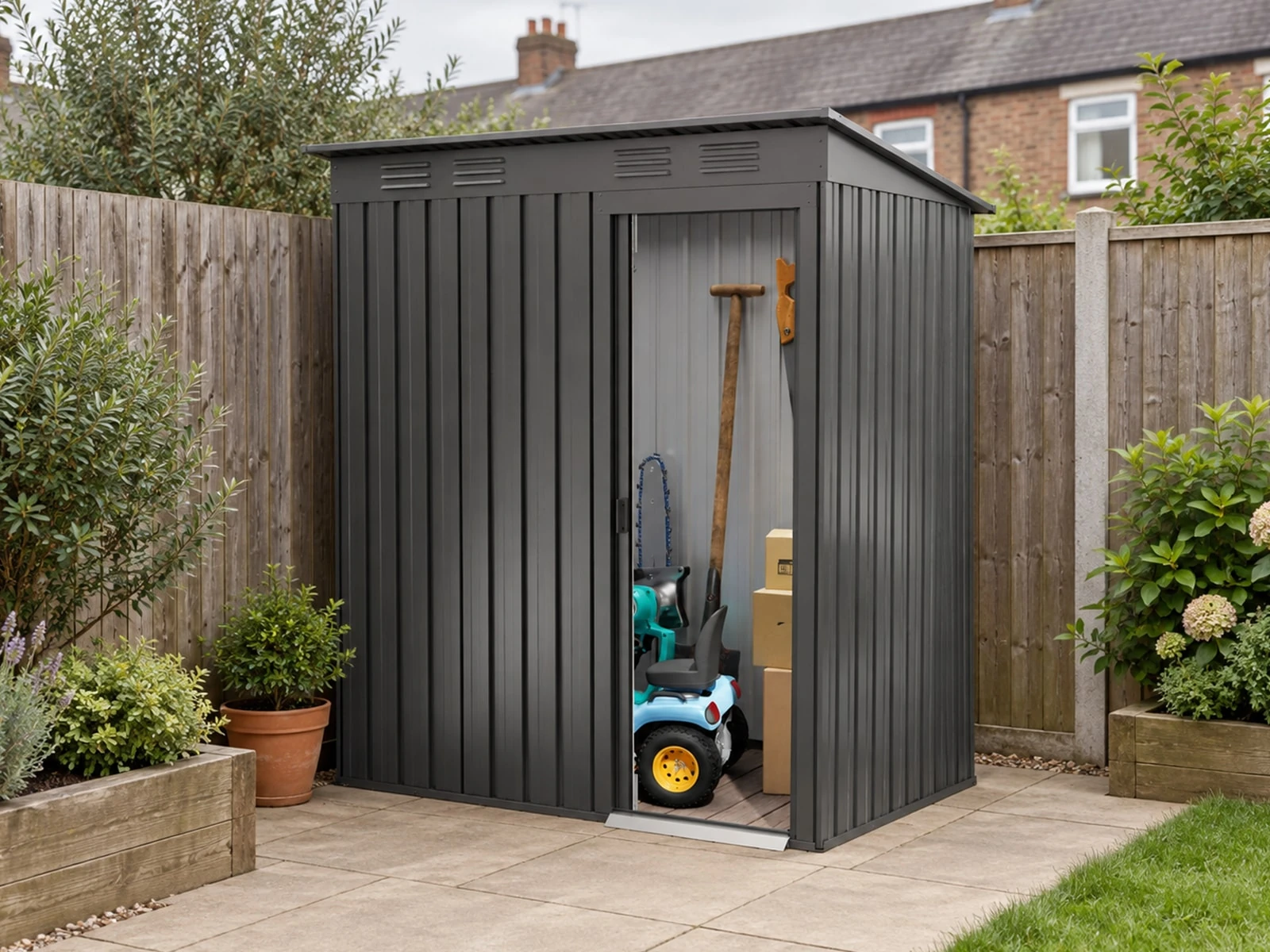
O que os compradores devem verificar nos abrigos em metal
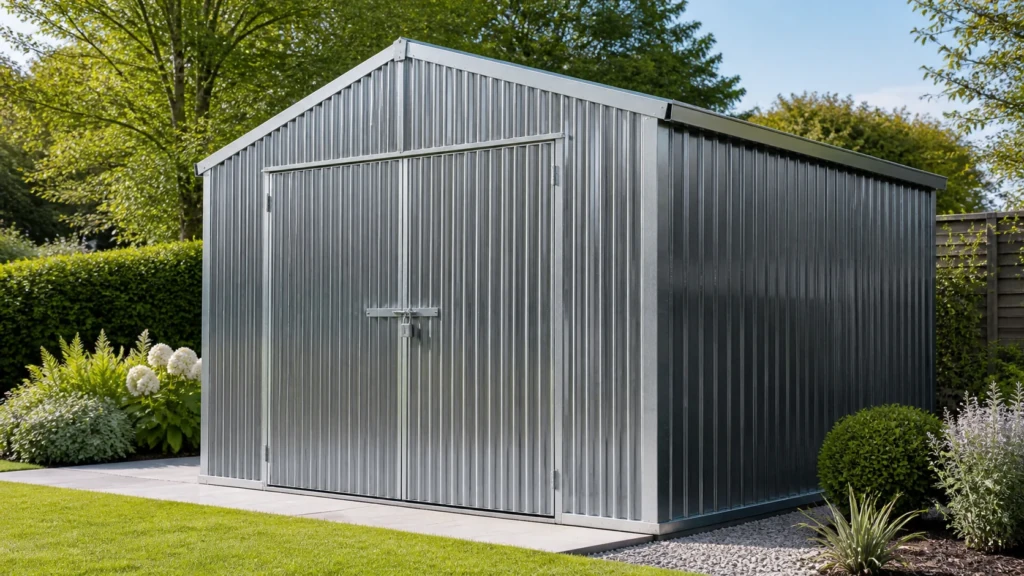
Reveja a forma do painel de parede e telhado, estrutura, base, portas, geometria do telhado, fixadores, revestimento ou acabamento, ventilação, acessórios e direção do piso como um sistema. Os registos da LERYOU incluem abrigos clássicos em aço corrugado, produtos com claraboia, abrigos de parede plana, direções reforçadas e combinações multifuncionais de abrigos. As dimensões e opções exatas dependem do produto selecionado.
Use o guia de materiais e estrutura de abrigos em metal para organizar os campos técnicos e o guia de tipos de abrigos de jardim em metal para definir os papéis da gama.
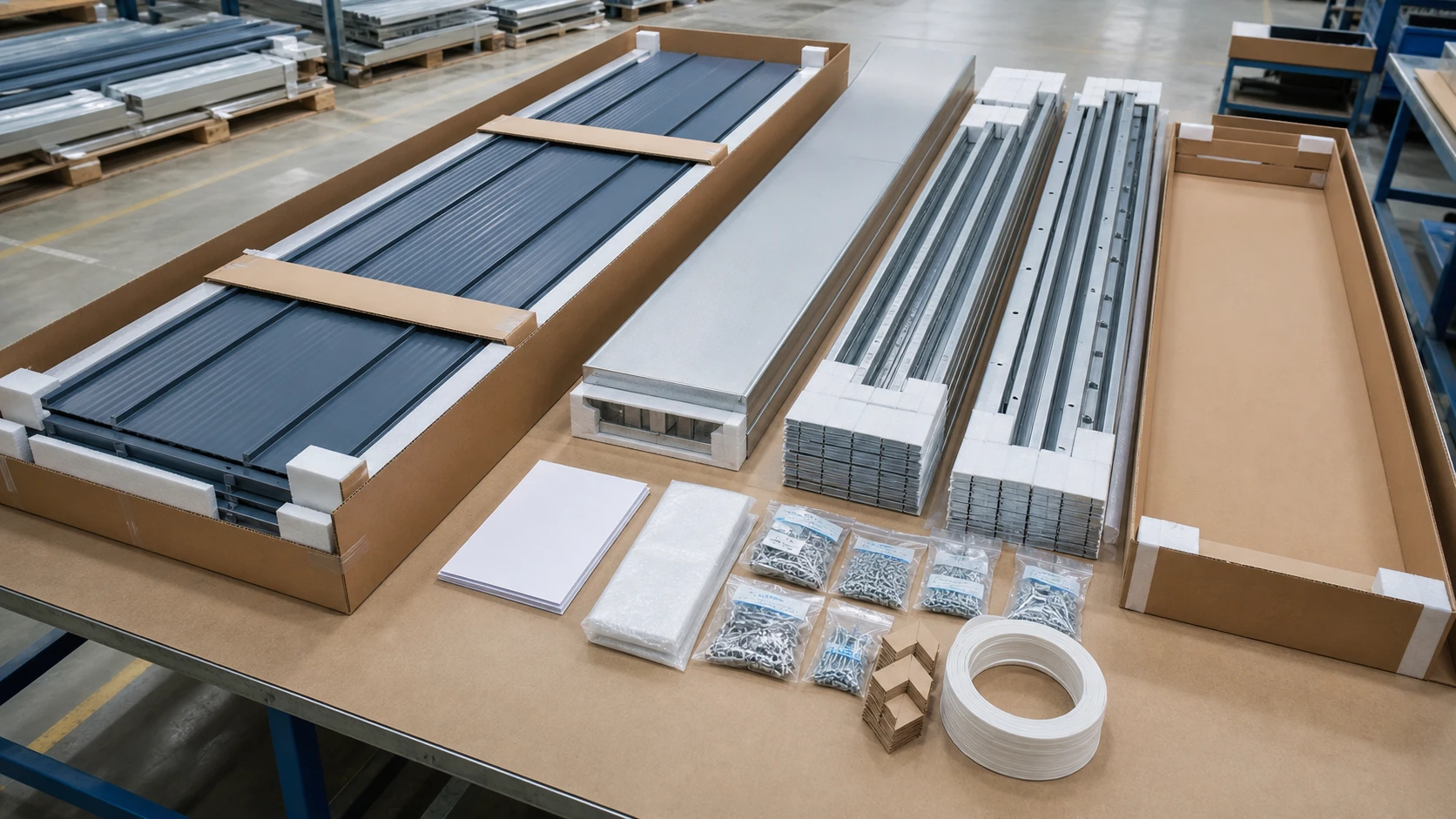
Embalagem e montagem podem alterar o resultado comercial
A material that looks attractive in a catalogue may create high handling or support costs if the pack is poorly designed. Request carton dimensions, weights, component protection, hardware separation, part labels and manual revisions after the configuration is fixed. Test the actual assembly sequence rather than relying on an “easy assembly” claim.
Can installation times be compared? Only if the examples use equivalent size, foundation readiness, number of installers, tools and completion standard. Record the actual model, test conditions and steps. A generic claim that all resin, wood or metal sheds take a certain number of hours is not a reliable retail promise. A workshop-style shed also needs a separate review of intended use, access, foundation and any services; it should not be treated as a storage shed merely because the outer dimensions match.
Não copie alegações genéricas de durabilidade
Declarações sobre clima, corrosão, UV, vento, neve, fogo e manutenção exigem suporte específico para o produto e o mercado. Peça a cada fornecedor que identifique quais evidências se aplicam ao material, estrutura, tamanho e configuração exatos. Mantenha comparações sem suporte fora da embalagem e das listagens de produtos.
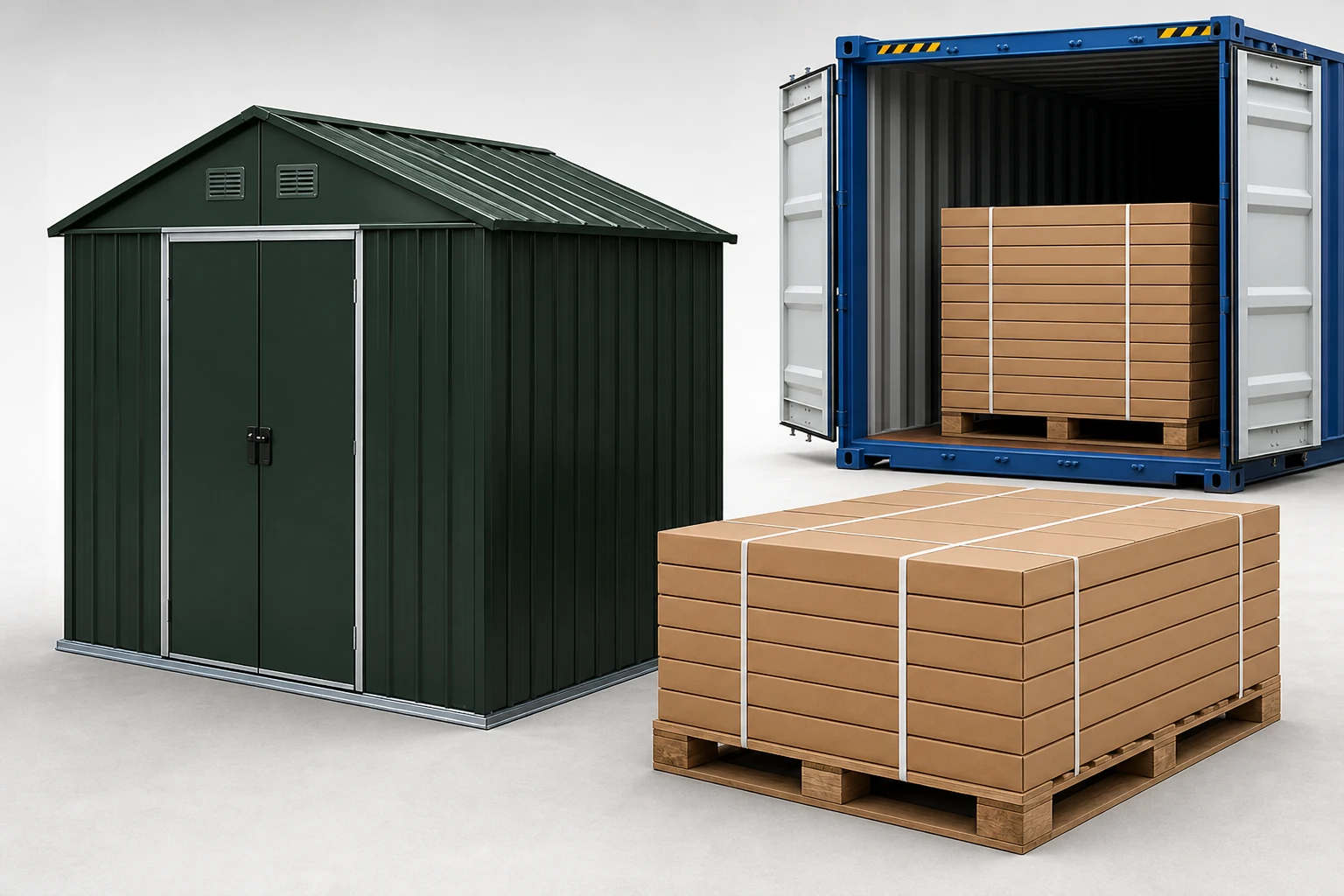
Campos de RFQ para uma comparação justa de materiais
- Mercado-alvo, canal, utilização prevista e posicionamento de preço.
- Pegada necessária, altura, acesso e direção dos artigos armazenados.
- Campos de material, estrutura e acabamento que cada fornecedor deve divulgar.
- Expectativas de base, piso, ventilação e acessórios.
- Requisitos de embalagem, rotulagem, manual e identificação pós-venda.
- Provas exigidas para alegações no mercado de destino.
- Gama de quantidades, destino e processo de aprovação.
Perguntas frequentes
There is no universal winner. Compare the selected model’s structure, finish or treatment, joints, base, installation instructions and evidence for the expected site conditions. Metal, resin and wood each have different failure and maintenance points.
Compare equivalent models using landed cost, carton handling, assembly support, expected maintenance and replacement parts. Material alone does not establish a reliable price or lifetime-cost ranking.
Not by category alone. Review the exact resin formulation and reinforcement alongside the metal shed’s coating and connections or the wood shed’s treatment and moisture detailing. Ask for model-specific evidence.
Yes, but only with comparable size, prepared base, installer count, tools and completion criteria. Ask each supplier for a model-specific assembly test or documented steps instead of a universal time claim.
Assess the selected shed’s corrosion, moisture or UV-related details and its maintenance instructions for that location. The material name alone does not prove suitability.
No. Structure, material specification, dimensions, connections, base, assembly and supporting evidence determine the answer for the selected model.
Choose according to customer use, price architecture, package limits, installation expectations, maintenance story and the team’s ability to support each product accurately.
LERYOU’s current garden shed offer is metal-led. Resin and wood are comparison categories in this guide; any other supply scope must be confirmed before it enters an RFQ.
Compare external and usable dimensions, frame, walls, roof, base, doors, ventilation, hardware, accessories, packaging, instructions, evidence, exclusions and after-sales parts.
Rever uma gama de abrigos de jardim em metal
Explorar soluções para galpões de jardim, rever a direção do produto de abrigo de jardim em metal, ou envie à LERYOU o seu briefing de produto para uma revisão de configuração.
Content scope reviewed against LERYOU’s current product knowledge records in October 2026. Final specifications, packaging, evidence and supply scope must be confirmed for the selected product and destination market.
 English
 Deutsch
 Français
 Español
 Italiano
 Polski
 日本語
日本語 한국어
한국어 Nederlands
 Čeština
 Português do Brasil
 Русский