A retail greenhouse range should not be built by collecting disconnected models until the catalogue looks full. For a product manager, the better question is: what role does each greenhouse play in the range, and why would a buyer stock more than one?
This article explains a practical range-planning method for product managers, retail buyers, importers and distributors. It is designed for teams preparing a product brief before supplier quotation, sample review or category planning. It does not prescribe fixed sizes, prices or model counts. Final availability, specifications and commercial terms must be confirmed for the selected LERYOU product direction.
If your team is still choosing between product families, start from 온실 및 재배 솔루션. If you already know the program should focus on polycarbonate, review the Polycarbonate Greenhouse range and use this guide to shape the assortment logic.
1. Start with the channel, not the model list
Different channels create different product questions. A garden center may care about display clarity and a range that is easy to explain. An e-commerce seller may care more about carton control, product images, listing data and after-sales questions. A distributor may need products that can serve several customer types without creating too many slow-moving SKUs.
Before selecting models, define:
- target market;
- sales channel;
- customer group;
- whether the range is retail, wholesale, e-commerce or private label;
- number of products the buyer expects to manage;
- packaging and documentation needs;
- whether the buyer wants standard selection or product development support.
This keeps the range from becoming a pile of attractive but overlapping products.
2. Give every product a role
A strong range normally contains roles, not just dimensions. A product manager can use three simple tiers:
| Tier | Role | What to check |
|---|---|---|
| 주요 제품군 | Broadest fit for the target channel | Clear customer use, stable product story, manageable packaging and documentation |
| 차별화된 제품 라인업 | Gives the buyer a reason to stock a second option | Different structure, material direction, style, access or use case |
| 전문 제품군 | Serves a narrower buyer need | Only add when product facts, images and channel logic are clear |
The goal is not to label one product as “best”. The goal is to stop several products from doing the same job.
3. Separate product family from size
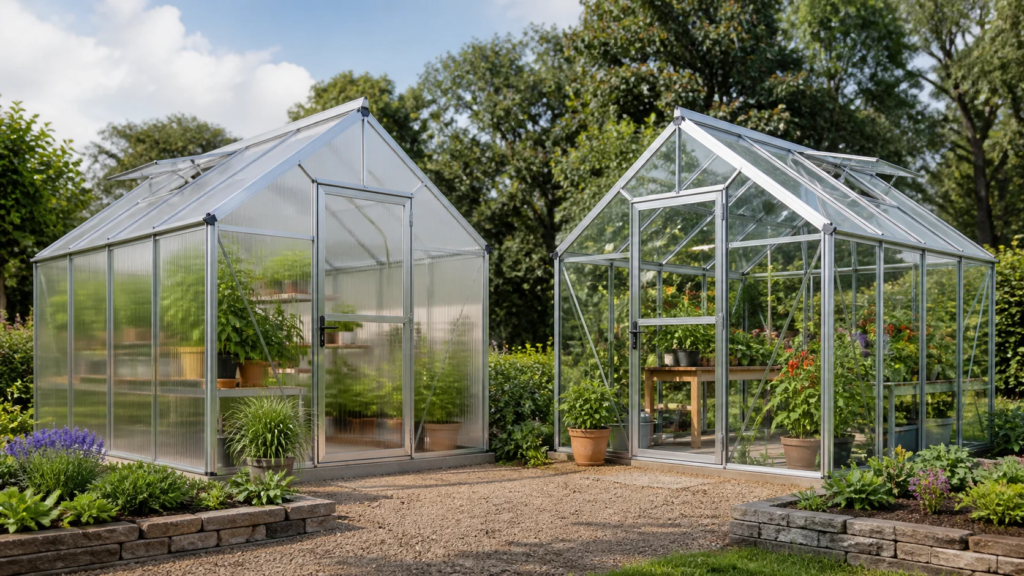
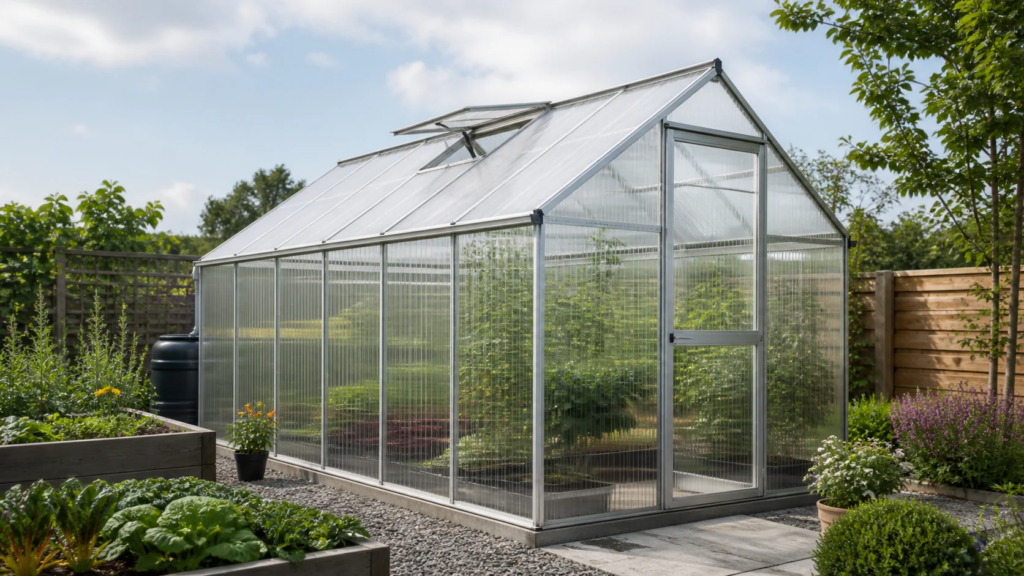
Greenhouse planning often jumps to size too quickly. Size matters, but product family matters first. A compact nursery product, a polycarbonate walk-in greenhouse and a glass greenhouse may serve different range roles even when a buyer informally groups them under “greenhouse”.
Use product family links as planning anchors:
- Polycarbonate Greenhouse for practical garden greenhouse range development;
- 유리 온실 for buyers considering a stronger visual or glazing direction;
- 묘목 및 재배 for compact seasonal or complementary growing products.
If the buyer is comparing materials, link to Polycarbonate vs Glass Greenhouse rather than repeating the full comparison inside the range-planning article.
4. Plan size steps without creating SKU overlap
Size steps should create meaningful choice. If two models are too close in buyer role, footprint direction, configuration and channel position, they may compete with each other instead of strengthening the range.
Product managers can evaluate size steps with these questions:
- Does the next size serve a different customer need?
- Does it change the channel story, or only the number in the title?
- Does packaging become more complex?
- Does the model need different instructions, cartons or after-sales data?
- Is the larger or smaller model supported by clear product images and specifications?
- Can the buyer explain why both products belong in the range?
Avoid forcing 6ft, 8ft or 10ft into separate article or product-page logic unless the search intent and product facts support it. If the size difference only helps comparison, it may belong inside a size guide or range-planning section rather than a separate thin page.
5. Use configuration to create real differentiation
Range differentiation can come from more than size. Product managers should review:
- freestanding vs lean-to direction;
- door type and access;
- roof and wall structure;
- frame color and finish direction;
- panel or glazing family;
- vent position and operation;
- base or anchoring provision;
- packaging and manual requirements;
- whether the product supports private-label needs.
Do not assume every option is compatible with every model. Record configuration ideas as “requested” or “open for review” until the supplier confirms the selected platform.
6. Build a retail range matrix
The range matrix should be short enough to use. A practical version may look like this:
| Product role | 제품군 | Size direction | 차별화 | Key open checks |
|---|---|---|---|---|
| Core | Polycarbonate greenhouse | Compact or mid-size class | Practical garden use | Final model, carton plan, manual needs |
| Upgrade | Polycarbonate or glass direction | Larger or more visual format | Appearance, access, glazing direction | Compatibility and packaging |
| Complement | Nursery/growing product | Smaller seasonal format | Add-on or seasonal use | Product data and channel fit |
| Specialist | Lean-to or special structure | Site-specific format | Space-saving or structure-specific use | Installation context and evidence |
This table helps the buyer and supplier discuss a range without pretending every detail is final.
7. Decide what should be standardized
Too much variation creates work. Product managers should decide which items should stay consistent across the range:
- frame color direction;
- packaging information structure;
- manual layout style;
- label and barcode placement;
- image naming and product data fields;
- spare-part identification logic;
- document approval workflow.
Standardization does not mean all products are identical. It means the buyer can manage the range without rebuilding every document from scratch.
8. Decide what can vary by channel
Some details should be adjusted by channel:
- e-commerce may need stronger product data, clearer package information and installation explanation;
- garden centers may need a more visual product story and display-friendly range logic;
- wholesale distributors may need fewer, clearer core products;
- private-label buyers may need packaging, artwork and manual approval records.
Use 온실 OEM/ODM 그리고 기능 as process links when discussing customization or project coordination. Do not convert process support into promises about timing, cost or availability.
9. Prepare a range brief before asking for quotations
A product range quotation should not start with “send prices for all greenhouses.” That creates weak offers and unnecessary follow-up.
A stronger range brief includes:
- target market and channel;
- product family focus;
- expected number of range levels;
- core/differentiated/specialist role logic;
- size direction;
- configuration preferences;
- packaging and document requirements;
- private-label needs if applicable;
- quantity range if available;
- open questions that need supplier review.
This gives LERYOU a better starting point for reviewing relevant greenhouse directions.
10. Common range-planning mistakes
Mistake 1: Selecting products only from images
Images are useful, but they do not confirm carton structure, manual requirements, panel details or compatibility.
Mistake 2: Adding too many similar sizes
If the customer cannot understand why two models exist, the range may create confusion rather than choice.
Mistake 3: Treating private label as only a logo
Private label can involve carton artwork, labels, manuals, barcodes, product data and approval steps.
Mistake 4: Comparing price before scope
A quote can look attractive if it leaves packaging, documents or configuration assumptions open. Use a range brief before comparing numbers.
Mistake 5: Using unverified performance language
Do not build the product story around wind, snow, thermal, UV, certification or warranty claims unless they are verified for the selected model and market.
자주 묻는 질문
How many greenhouse models should a retailer carry?
There is no universal number. The product manager should define range roles first, then choose enough products to cover the channel without creating unnecessary overlap.
Should polycarbonate and glass greenhouses be in the same range?
They can be, if they serve different product roles and the buyer can explain the difference clearly. If the material decision is still open, use a material comparison guide before locking the range.
Should a size guide or range-planning guide come first?
Range logic should come first when the buyer is planning assortment structure. A size guide is useful when the buyer already knows the product family and needs help comparing footprint direction.
CTA: Discuss a greenhouse range plan
If your team is planning a greenhouse range for retail, wholesale, e-commerce or private-label channels, prepare a simple range brief before requesting a quotation. Review LERYOU’s 온실 및 재배 솔루션, 살펴보기 폴리카보네이트 온실, 또는 LERYOU에 문의하기 with your target market, channel, product roles, size direction and packaging requirements. Final specifications, commercial terms and timing should be confirmed for the selected program.
 English
 Deutsch
 Français
 Español
 Italiano
 Polski
 日本語
日本語 한국어
한국어 Nederlands
 Čeština
 Português do Brasil
 Русский